
How to Find Recently Released Harris County Inmates
There is no dedicated release list for Harris County. The Sheriff's Office handles release status through the same tools it uses for current custody. That means the standard inmate search, the Offense Inquiry tool, the VINELink alert system, and a 24-hour phone line. When you run a name through the Sheriff's inmate portal and the person no longer shows as in custody, that is often your first sign of a release. The portal can also flag a custody status of released along with a release date when the data has caught up.
The Offense Inquiry tool adds more detail. If you have an offense or incident number, a Sheriff's personal number (SPN), a CDI code, or a Harris County cause number, you can pull whether the defendant is still in jail, when the person will be released if still held, and the next court setting or disposition. That last point matters. A release date tied to a case is more reliable than guessing from a roster gap. For the live roster and booking fields, the Harris County inmate records page walks through the search portal in full.
Released inmates leave from the Joint Processing Center. People exit there once the paperwork clears.
Online jail data lags behind the booking desk. A record can show in custody for hours after a person has actually walked out, and the reverse happens too. When timing is critical, the phone beats the screen. The Sheriff's incarcerated person information line runs around the clock and can confirm a current status that the website has not updated yet.
Setting Up Harris County Release Alerts
You do not have to keep checking the roster by hand. VINELink, the victim notification network, sends an alert when a person's custody status changes. It works for victims, but anyone can register. The service is free. You pick a person, choose how you want to be told, and the system pings you on release, transfer, or other custody events where Texas data feeds the network. For Harris County, this is the cleanest way to track a release without watching the screen all day.
Registration is short. The setup below is the standard flow at VINELink.
- Open the VINELink site and select Texas as the state or jurisdiction.
- Search by name, or by offender ID or booking number if you have one.
- Pick the matching record, then register for alerts by phone, email, or text.
- Set a PIN if asked, and confirm the contact method so the alert can reach you.
VINELink is a dynamic site, and the exact screen shifts by state. The image below comes straight from the VINELink victim notification site.
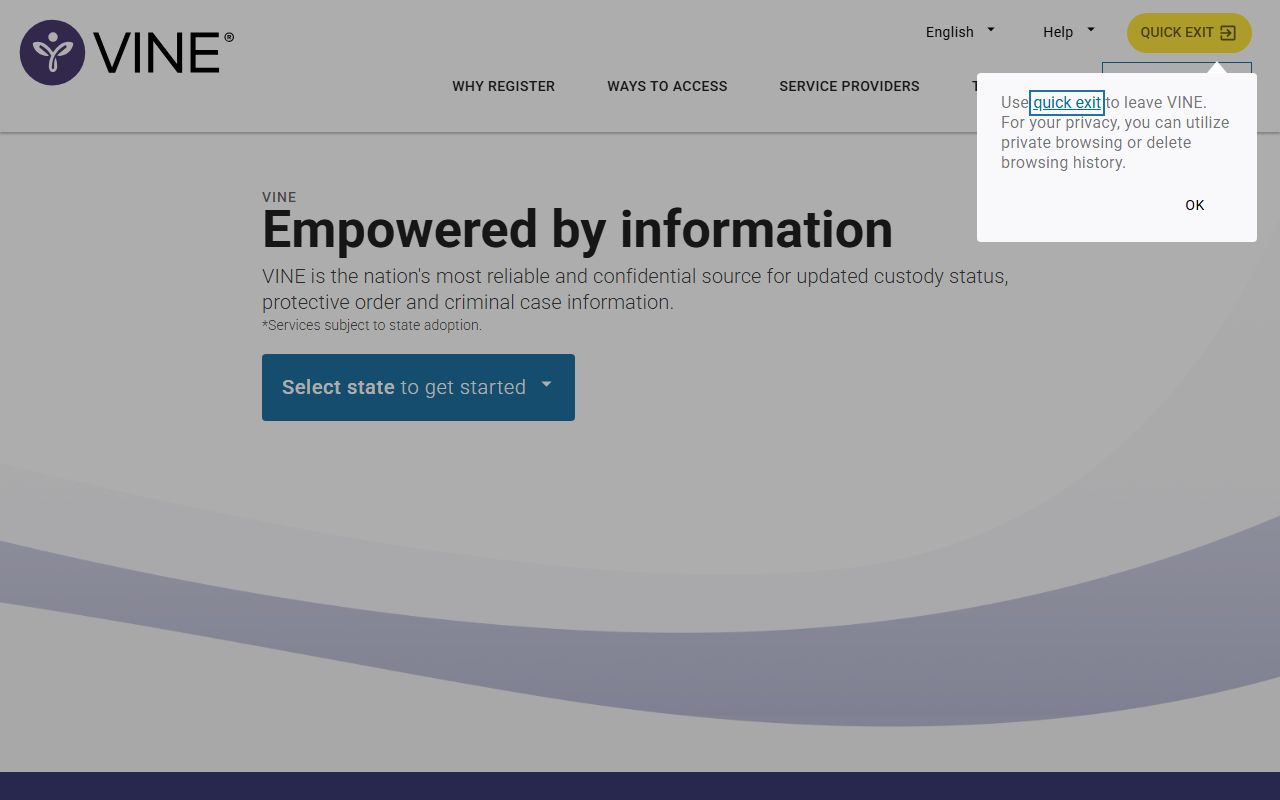
The fields you use to register are short and mostly optional, which keeps the search fast.
| Field Label | Type | Required | Notes |
|---|---|---|---|
| State / Jurisdiction | Dropdown / search | Yes | Select Texas or the local jurisdiction |
| Name | Text | Optional | Person search by name |
| Offender ID / Booking Number | Text | Optional | Search by ID if you know it |
| Notification Method | Form | Required for alerts | Phone, email, or text options vary |
Note: VINELink alerts are a backup, not a guarantee, so confirm any custody change with the Sheriff's Office before you act on it.
Searching State Released Inmates in TDCJ
Not everyone released from the Harris County Jail goes free. Many move on to state prison. When a person is sentenced to a term in a state unit, custody shifts from the county to the Texas Department of Criminal Justice. At that point the county roster will not help you. You search the TDCJ inmate locator instead. The TDCJ search at inmate.tdcj.texas.gov covers people held in state units across Texas.
A few limits matter. The TDCJ search only includes current TDCJ inmates. It does not list county detainees, federal inmates, or people already discharged from state custody. The data is updated on working days only and is at least 24 hours old. So a fresh transfer may not show right away. If you plan to pick someone up or visit, TDCJ advises calling the unit first. The smallest search that works is a last name plus a first initial, a TDCJ number, or an SID number.
The locator accepts a name or an ID. Here are the search fields.
| Field Label | Type | Required | Notes |
|---|---|---|---|
| Last Name | Text | Conditional | Exact last-name match; pair with a first initial for a name search |
| First Name | Text | Conditional | A first initial is enough when paired with a last name |
| TDCJ Number | Text | Conditional | The TDCJ ID number |
| SID Number | Text | Conditional | State identification number |
| Gender | Dropdown | Optional | All, Female, or Male |
| Race | Dropdown | Optional | All, American Indian, Asian or Pacific Islander, Black, Hispanic, White, Unknown |
| Search | Button | n/a | Submits the search |
Note: TDCJ data is at least a day old, so call the housing unit directly when you need a current location or release date.
Searching Federal Released Inmates in BOP
Federal cases follow a separate track. A person charged in federal court out of Houston is held under the Federal Bureau of Prisons, not the county or the state. To find them, use the BOP inmate locator at bop.gov/inmateloc. It covers federal inmates from 1982 to the present. You can search two ways. One mode looks up a person by an ID number. The other searches by name. The number mode accepts a BOP Register Number, a DCDC number, an FBI number, or an INS number.
Read federal release dates with care. The BOP warns that a posted release date may not be current because First Step Act time credits can move it. A status of "Released" or "Not in BOP Custody" does not always mean a person is free. They may still be in another justice system or on supervised release. Treat the date as a planning estimate, not a fixed fact.
The BOP search fields differ between the number tab and the name tab.
| Field Label | Type | Required | Notes |
|---|---|---|---|
| Find By Number / Find By Name | Tab | Yes | Two search modes to choose from |
| Type of Number | Radio / dropdown | Yes in number mode | BOP Register, DCDC, FBI, or INS Number |
| Number | Text | Yes in number mode | BOP Register format is #####-### |
| First | Text | Yes in name mode | First name |
| Middle | Text | Optional | Middle name |
| Last | Text | Yes in name mode | Last name |
| Race | Dropdown | Optional | American Indian, Asian, Black, White |
| Age | Text | Optional | Age filter |
| Sex | Dropdown | Optional | Male, Female |
A BOP result returns a short profile. Here is what each match shows.
| Field | What It Shows |
|---|---|
| Name | The inmate's full name as booked by the BOP |
| Register # | The federal register number for the person |
| Age | Current age of the inmate |
| Race | Race as recorded by the BOP |
| Sex | Sex as recorded |
| Release Date | Projected or actual release date; may shift under First Step Act credits |
| Location | The facility or status, such as a named unit or "Released" |
The profile also links out to call or email, send mail, send money, set up a visit, or voice a concern about the inmate.
Verifying a Harris County Release in Person or By Phone
When the online roster is unclear, go to the source. The Harris County Sheriff's Office runs a 24-hour incarcerated person information line. A call there can confirm a current custody status, a release, or whether a person has been moved. This is the fastest fix when the website still shows a person as held but you think they are out. The Sheriff's Office, led by Sheriff Ed Gonzalez, posts these lines on the Harris County Sheriff's Office website.
Release also involves property and money. Both have rules and time limits. A person picking up a released inmate's property must appear in person between 8:00 a.m. and 9:00 p.m. at the facility where the inmate is housed, show valid ID, and get the inmate's authorization first. Property is then claimed at 700 North San Jacinto. Property must be claimed within 24 hours or the release form is no longer valid. Money works much the same way.
- Property and money are released only between 8:00 a.m. and 9:00 p.m.
- The inmate must sign and thumbprint a Money Release form.
- The minimum withdrawal is $20.
- A $10 minimum balance must stay in the account.
- The person withdrawing must appear at the visitor control center with a government photo ID.
Keep the contact details below handy for release questions and pickups.
HCSO Release Information
Joint Processing Center
700 N. San Jacinto Street
Houston, TX 77002
713-755-5300
The Texas Sex Offender Registry
Some people who leave custody carry a registration duty. Texas keeps a public sex offender registry through the Department of Public Safety. It is a separate database from any jail roster or prison locator. You can search it by name, by birth date, or by mapping an address to see registrants in a given area. The registry at sor.dps.texas.gov covers people required to register statewide, including Harris County. A campus search option lets you check registrants tied to a higher education institution.
Search is flexible. Most fields are optional, so you can run a broad name check or a tight address map.
| Field Label | Type | Required | Notes |
|---|---|---|---|
| Map Address / Address | Text / map | Optional | Address-based map search of nearby registrants |
| Last Name | Text | Optional | Registrant last name |
| First Name | Text | Optional | Registrant first name |
| Birth Date | Date | Optional | Date of birth field |
| Institute | Dropdown | Optional | Higher education institution list |
| Campus | Dropdown | Optional | Loads based on the chosen institute |
| Clear | Button | n/a | Resets the form |
| Search | Button | n/a | Submits the search |
The registry is public, but not every record about a released person is. To check active warrants on someone who is out, the Harris County warrant records page covers that search.
Parole and Probation After Release
Release is rarely the end of the case. Many people leave custody under supervision. Parole applies to those released from state prison before their full sentence is served. Probation, called community supervision in Texas, is set by the court in place of or after jail or prison time. Both come with conditions. A person may have to report to an officer, hold a job, avoid certain places, and stay clean. Break a condition and supervision can be revoked, which can send the person back into custody.
Parole in Texas runs through the state, not the county. The Texas Board of Pardons and Paroles decides parole, and the TDCJ Parole Division supervises people once they are out. To report a concern or check supervision basics, the state parole resources are the right contact. Community supervision in Harris County is handled locally by the county supervision department, which is the office that monitors probationers and reports violations to the sentencing court.
For state parole and reentry programs, the Texas Department of Criminal Justice is the lead agency.
TDCJ Parole Division
Texas Board of Pardons and Paroles
Parole decisions and state supervision
Reentry Resources in Harris County
Getting out is hard. People come home needing housing, work, ID, and often treatment. Harris County and the state both run programs to ease that path. Mental health and substance use support is a big piece, since many people leaving the jail have a documented need. The Harris Center is the local mental health authority and runs adult justice services that connect released people to care. State and local groups fill the other gaps, from job help to free legal aid.
- The Harris Center, adult justice services and mental health support for people leaving custody.
- Texas Workforce Commission, job search, training, and placement help across the state.
- Goodwill Houston, work programs and job training for people rebuilding after release.
- Lone Star Legal Aid, free civil legal help for low-income Texans.
- Houston Volunteer Lawyers, pro bono civil legal services for eligible Harris County residents.
- Texas Reentry and Integration Division, the state office that coordinates reentry planning.
Health records tied to treatment are tightly protected. Mental health records in Texas are confidential under state law, which limits who can see them even after release. The image below is from Texas Health and Safety Code Chapter 611, the chapter on mental health record confidentiality.
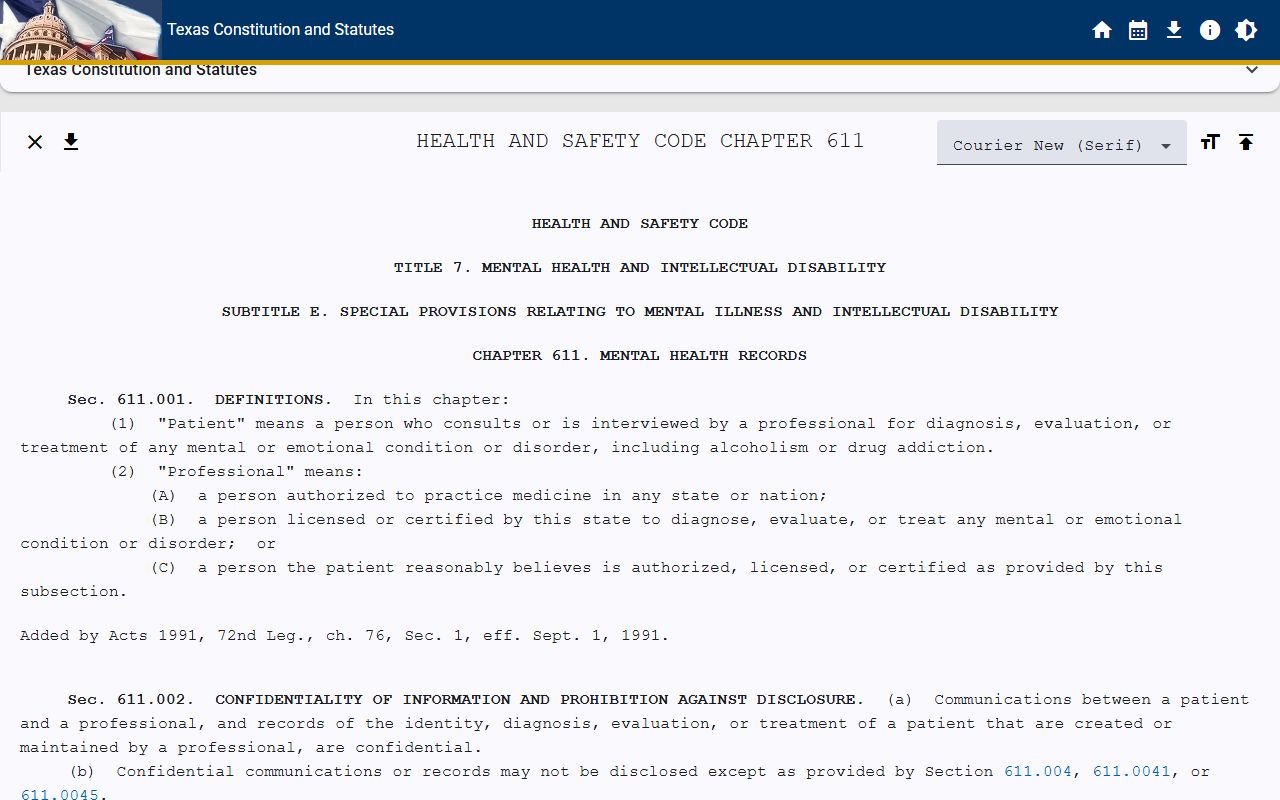
That confidentiality matters in reentry, because treatment records stay private as a person works through housing, jobs, and supervision. Below is a key local resource for the mental health side of reentry.
The Harris Center
Adult Justice Services
Harris County mental health authority
Reentry and treatment referrals
Note: Many reentry programs check eligibility, so call ahead with the basics of the case and the kind of help you need.
Civil Rights Restoration After Release
A release brings back some rights, but not all at once. Voting is the clearest example. In Texas, a felony conviction bars voting while a person is incarcerated, on parole, or on community supervision. The right to vote comes back after the full sentence is done, including any supervision. There is no extra application and no waiting period beyond finishing the sentence. Once supervision ends, a person can register to vote again like any other resident.
Firearm rights are tougher and they vary by offense. State and federal law both weigh in, and the rules are not simple. Anyone with a felony record should get legal advice before assuming a firearm right is restored. Employment rights are different again. A record can show up in background checks, though sealing or expunction may limit what an employer sees. The Harris County arrest records page covers how charges, convictions, and sealed records appear in a search.
Some records stay confidential no matter a person's release status. Adoption records are one example, kept private by state law. The image below is from Texas Family Code Chapter 162, the chapter that governs adoption and the confidentiality of adoption records.
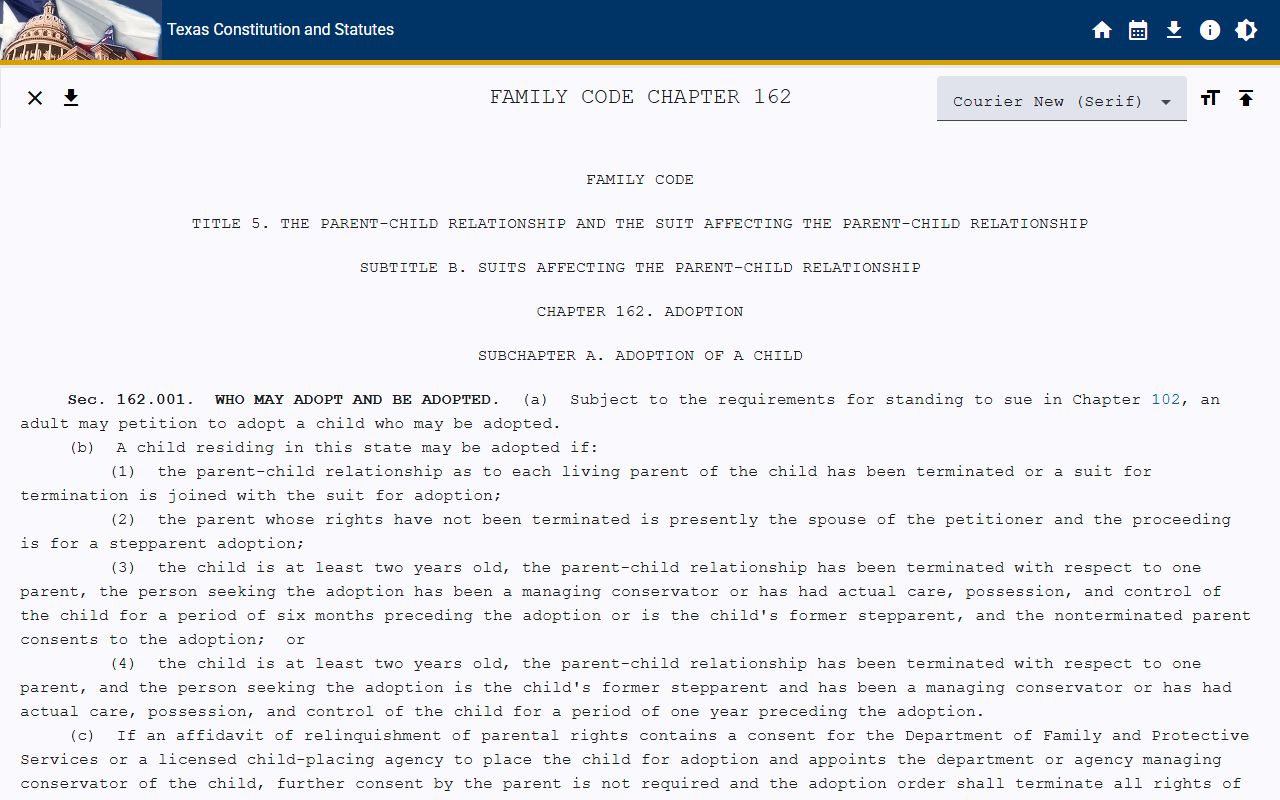
The point is simple. Release restores some civil standing, yet courts and statutes still seal whole classes of records. Knowing which rights return and which records stay closed helps a released person plan the next steps. For the broader public access framework, the Harris County court records page lays out what is open and what is sealed.