
Getting a Marriage License in Harris County
Marriage licenses in Harris County come from the County Clerk Personal Records Department, run under County Clerk Teneshia Hudspeth. The main office sits at 201 Caroline, Suite 330, in downtown Houston, and the phone number is 713-274-8686. You do not have to use the downtown office, though. Both applicants can apply in person at any one of 11 County Clerk locations spread around the county. That gives most couples a branch close to home.
Both people need a valid government ID. A Texas driver's license works. So does a DPS ID card, a valid passport, a resident alien card, or another U.S. government photo ID. There is a 72-hour waiting period after the license is issued, and the license stays good for 90 days. The officiant signs it during that window. One rule trips people up often: if you were married before, you must be divorced at least 30 days before you apply. Witnesses are not needed to buy the license or attend the ceremony.
The County Clerk lays out all of this on its personal records page, which covers marriage licenses, informal marriage, and other vital documents. The screenshot below comes from the Harris County Clerk personal records page.
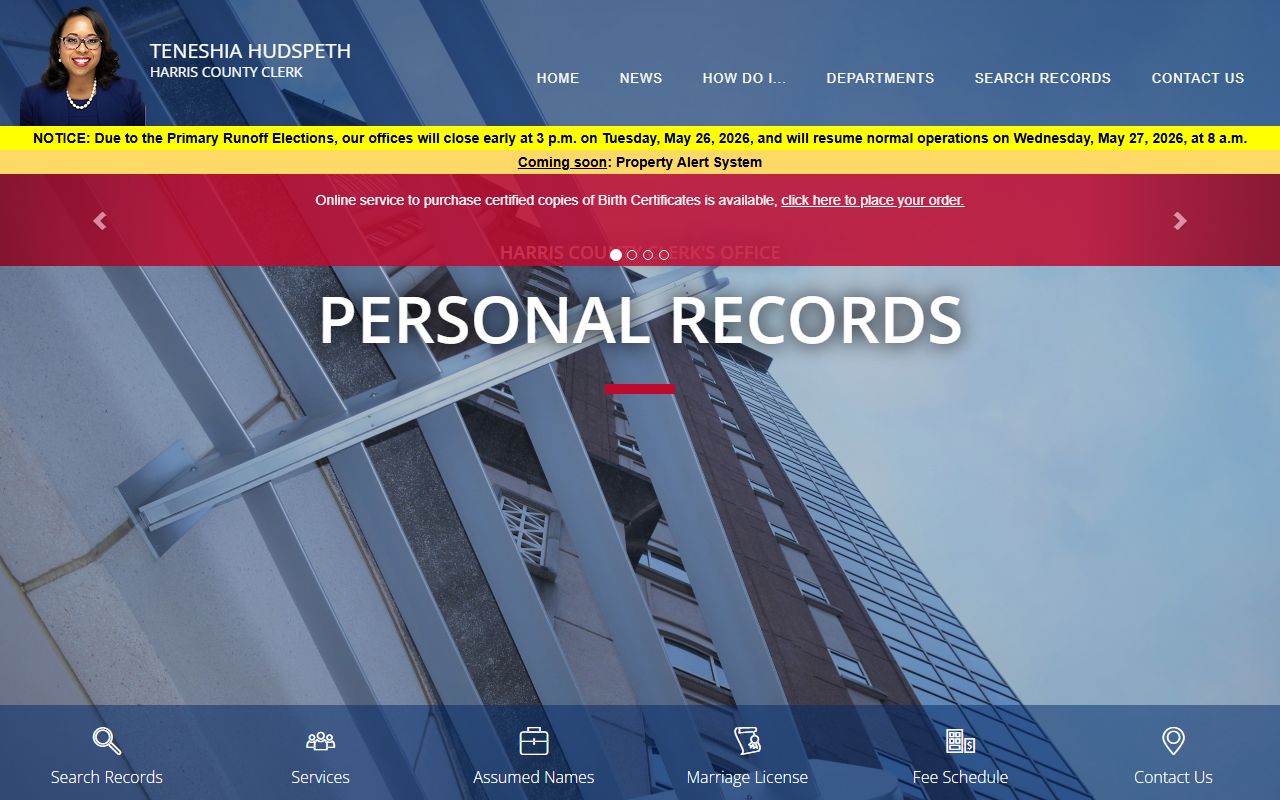
That page links the marriage license rules, the absent applicant affidavit, fee details, and the informal marriage process in one spot. It is the best starting point before you head to a counter.
How to Apply for a Marriage License
The process is short when you come prepared. Bring ID for both people and decide on the fee tier before you arrive, since residency proof changes the cost. If one person cannot make it to the counter, plan ahead for the absent applicant affidavit. Here are the steps the County Clerk follows.
- Confirm both applicants have valid ID, and that at least one shows Texas residency proof if you want the lower resident fee.
- If either applicant cannot appear, complete and notarize the Affidavit of Absent Applicant and provide a copy of that person's valid ID.
- Visit any Harris County Clerk location in person. No witnesses are required to apply.
- Pay the license fee at the counter, and ask about a Twogether in Texas certificate if either of you finished the course.
- Wait 72 hours after issuance unless a waiver applies. The ceremony must happen within 90 days.
- Have your officiant sign the license after the ceremony.
- Return the signed license to the County Clerk for recording, either in person or by mail.
- Wait one to two weeks for the original to come back, then order certified copies as needed.
The Twogether in Texas course is worth a mention. It can cut the fee by up to $60 and waive the 72-hour wait. For couples who plan ahead, that course pays for itself.
Marriage License Application Fields
The marriage license application asks each applicant for basic identity facts. You give your full legal name, your date of birth, and ID details. State law lets the clerk redact your Social Security number from the public application after the rules changed in 2003, so SSN data does not show in the public index. The County Clerk also runs a public marriage search portal where you look up an existing record. That search uses a smaller set of fields. The table below lists those marriage search fields.
| Field Label | Type | Required | Options / Format Notes |
|---|---|---|---|
| File Number | Text | No | Marriage file number; entering it avoids the search fee |
| Film Code | Text | No | Film or reference code if known |
| Applicant(s) | Text | No | Search by applicant name |
| Date type | Radio / select | No | Choose Issued Date or Marriage Date |
| From | Date / text | No | Start of the date range |
| To | Date / text | No | End of the date range |
You can run a name search alone. Adding a date range narrows the list. If you already have a file number or film code, use it, since that points straight to the record and skips the search fee.
Harris County Marriage and Divorce Fees
Marriage fees turn on one thing: residency proof. The license is $81 when at least one applicant shows valid Texas residency proof on an ID. Without that proof from either applicant, the fee jumps to $181. An informal marriage declaration, what most people call common-law marriage, costs $46. Certified copies ordered at the time of filing run $6 each. The table below sums up the common charges tied to marriage and divorce records.
| Item | Amount |
|---|---|
| Marriage license (with Texas residency proof) | $81 |
| Marriage license (no residency proof) | $181 |
| Informal (common-law) marriage declaration | $46 |
| Certified copy ordered at filing | $6 |
| Twogether in Texas course discount | Up to $60 off |
Divorce fees are different. A divorce is a civil family case in district court, so its filing fees and copy fees come from the District Clerk, not the County Clerk. Those costs vary by case and are set by the District Clerk civil and family fee schedules. Certified copies of a divorce decree are ordered from the District Clerk.
Note: A Twogether in Texas premarital course can cut the marriage license fee by up to $60 and waive the 72-hour waiting period.
How to Look Up Harris County Marriage Records
Marriage record searches run through the County Clerk online portal. You search by applicant name, by file number, or by film code, and you can limit results to a date range. The index reaches back further than most people expect. Ceremonial marriage records reflect filings accepted from June 13, 1929 forward. Informal marriage records start from January 2, 1970. The clerk even holds Freedmen's Bureau marriage records, listed as FMC records, for filings between November 10, 1865 and March 7, 1868. Document images are available from 1929 to the present.
The portal itself is simple, and you can view watermarked copies free once you register. The image below comes from the Harris County Clerk marriage license search.
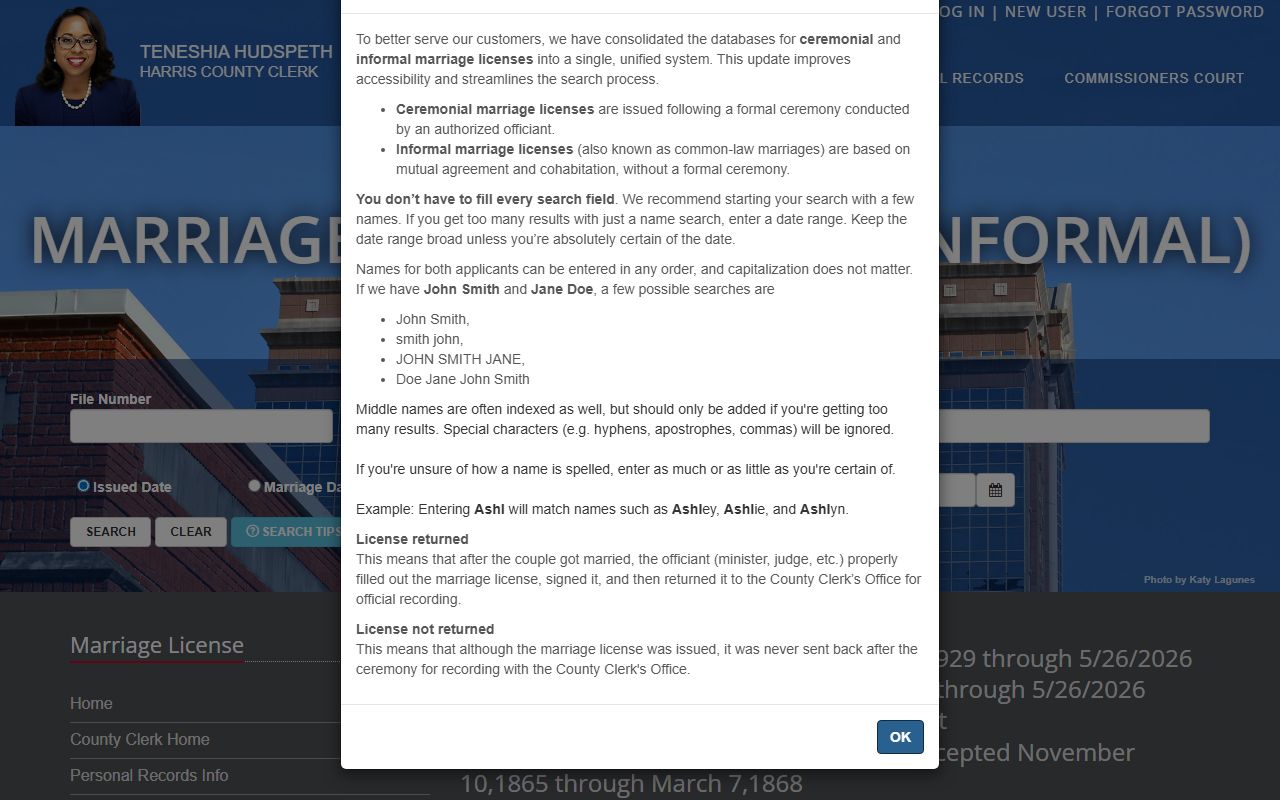
To find a record fast, have a name spelled the way it was filed, and pick the right date type. Issued Date and Marriage Date are not always the same. If your first search comes up empty, widen the date range or switch the date type before you assume the record is missing.
How to Find Harris County Divorce Records
Divorce is not a County Clerk matter. It is a family law case, filed in a Harris County district court, and the file lives with the District Clerk, Marilyn Burgess. You search divorce cases through the District Clerk civil and family search tools, the same Party Inquiry system used for other district court cases. A name search shows the case if it is public, along with the cause number, the court, the filing date, and the parties.
Here is the catch. Family case documents are held back from the public search. The District Clerk Party Inquiry tool states that no family documents are available for review through that portal. So you may see that a divorce case exists, but you will not pull the petition, the decree, or the financial filings online. Those papers stay private to protect the people involved.
Texas Family Code Chapter 6 governs divorce, including residency rules, grounds, and the decree process. You can read it on the official state site. The screenshot below is from Texas Family Code Chapter 6.
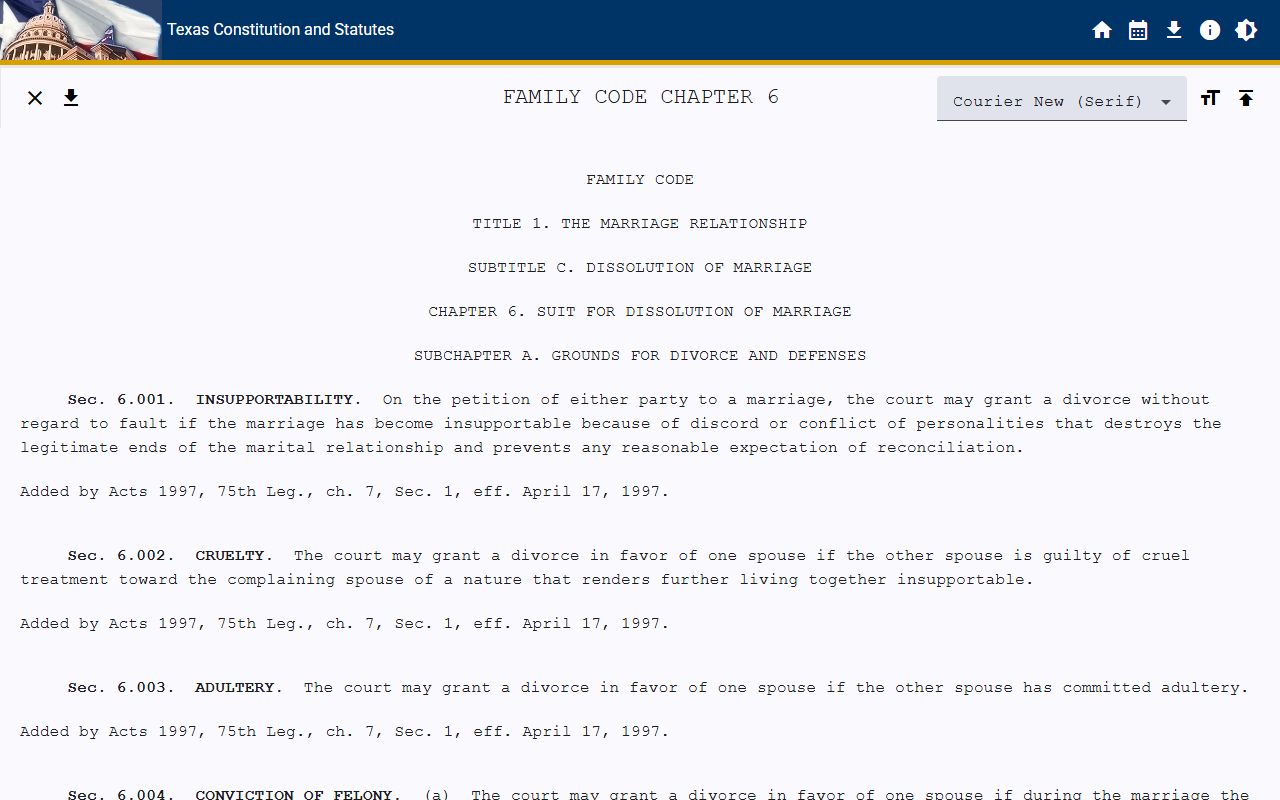
A typical divorce moves through a set of stages. The petitioner files an original petition. The respondent is served or signs a waiver. Temporary orders may follow if the couple needs them. Financial and parenting disclosures get exchanged as the rules require. Mediation or settlement may resolve the case. A judge then signs a final decree, and that decree is the document people most often need later.
Texas Marriage Law and Officiants
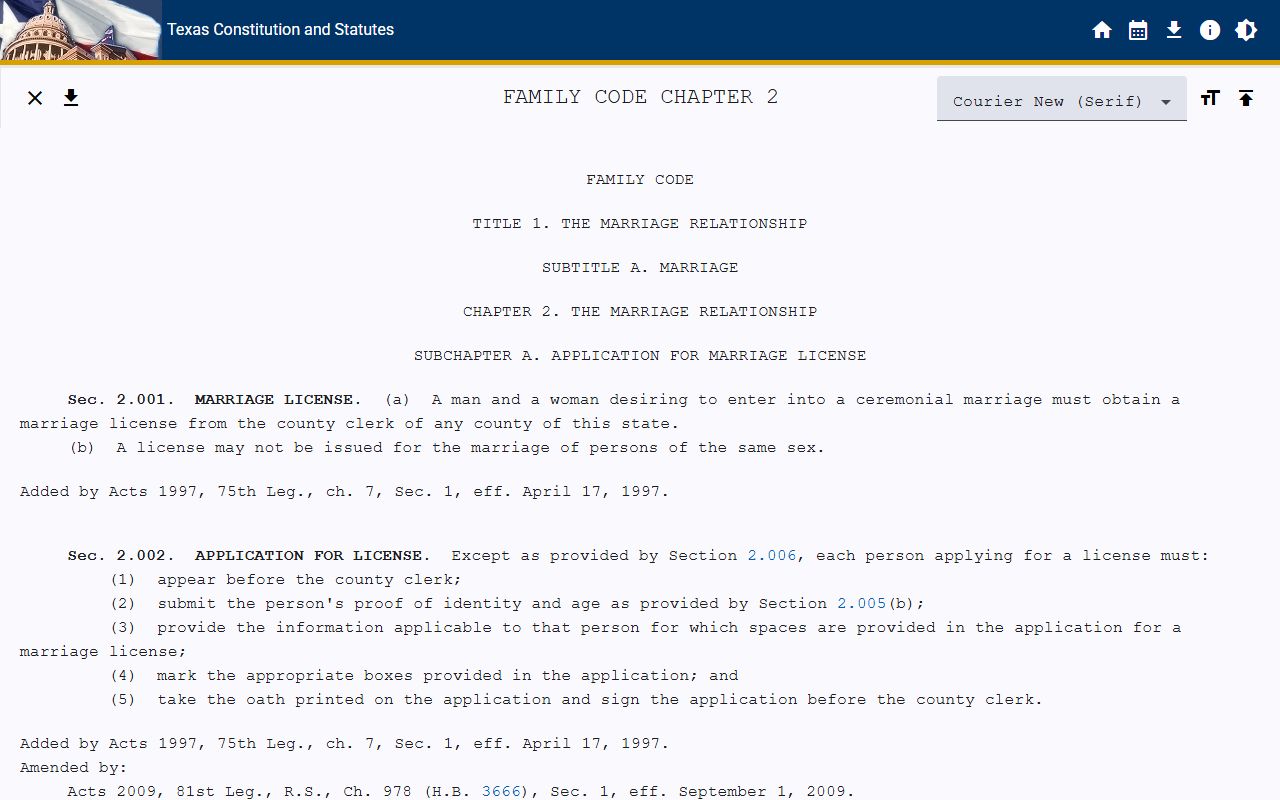
Texas Family Code Chapter 2 sets the rules for marriage. It covers the license application, the absent applicant affidavit, the 72-hour waiting period, the 90-day expiration, informal marriage, and who may perform a ceremony. Reading the actual code clears up a lot of questions about what the clerk can and cannot do.
The list of authorized officiants comes from Family Code § 2.202. It includes licensed or ordained Christian ministers and priests, Jewish rabbis, officers of authorized religious organizations, Texas and federal judges and magistrates, justices of the peace, retired judges, and municipal judges. The image below is from Texas Family Code Chapter 2.
Informal marriage gets its own path. To file a declaration of informal marriage, both people appear in person, show valid ID, list the date from which they have considered themselves married, and pay $46. That declaration creates a public record of the marriage even though there was no formal ceremony.
Getting Certified Copies
You often need a certified copy, not a plain printout, for legal or financial steps. A name change, a benefits claim, or a court filing usually calls for the certified version with the clerk's certification. For marriage records, certified copies cost $6 each when ordered at filing, and the County Clerk also sells copies later through its records process. For a divorce decree, you order the certified copy from the District Clerk, since that office holds the family case file.
Plan around timing. Original marriage licenses can take one to two weeks to come back after the ceremony and recording. If yours does not show up, call the Personal Records Department at 713-274-8686. A certified copy bought online is emailed and does not carry a raised seal, so some agencies that demand a raised seal will need an in-person or mailed request instead.
Important: A certified copy emailed from an online order has no raised seal, and some agencies will not accept it. When a raised seal is required, request the copy in person or by mail.
Other County Clerk Records
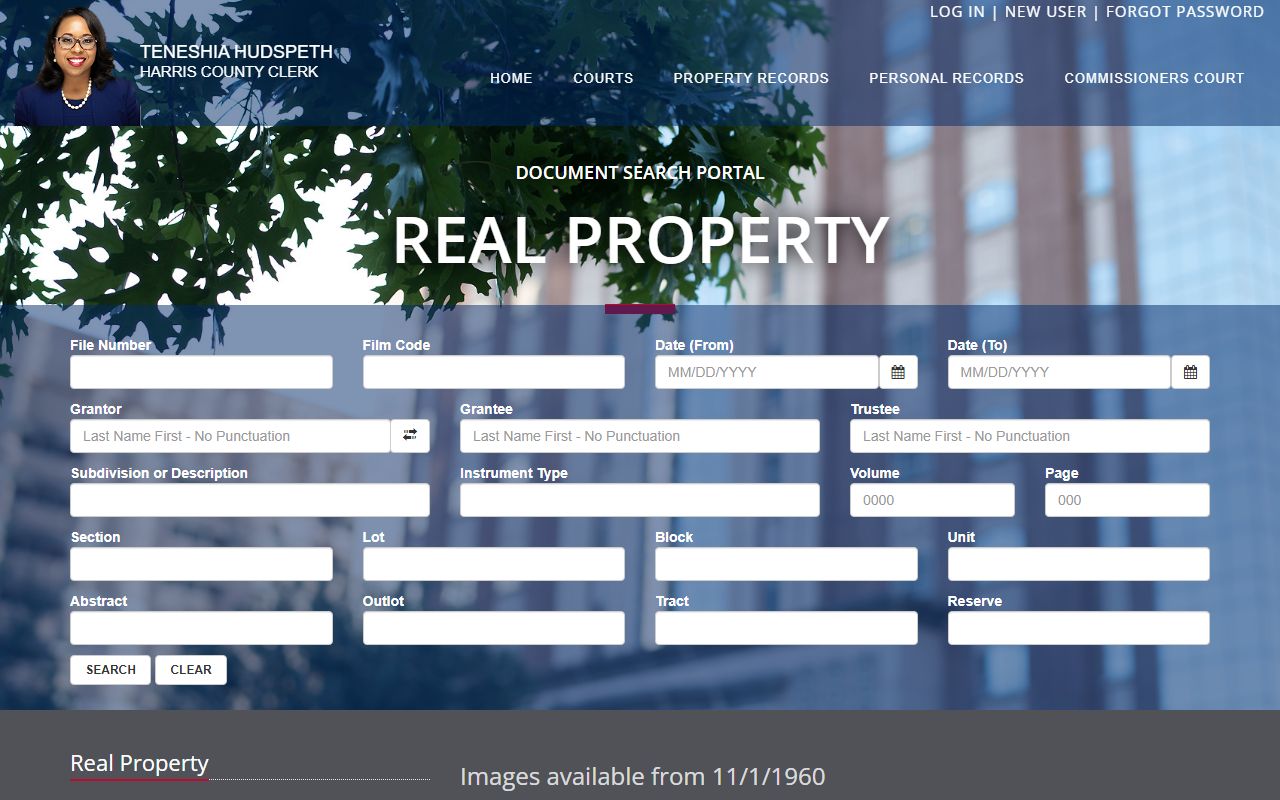
The same County Clerk document portal that holds marriage records also covers other vital and property filings. Real property records, maps and condos, assumed names, UCC filings, and miscellaneous personal records all sit in the same system. So a search trip for a marriage record can double as a check on a deed or a business name. The real property side uses its own search form with grantor, grantee, and legal description fields.
The County Clerk real property search shows how that portal works for land records. The screenshot below comes from the Harris County Clerk real property search.
For a fuller breakdown of land deeds, business filings, and the open-records framework, see the Harris County public records page. The Harris County Clerk page covers the office itself, its fees, and its hours in more detail.