
What Probate Covers in Harris County
Probate is the court process that settles what a person leaves behind. In Harris County it reaches well past wills. The probate courts handle estate administration, heirship when there is no will, guardianship of minors and incapacitated adults, trusts and probate-related lawsuits, and mental health proceedings. Each of these makes a record. A will admitted to probate becomes a public file. So does an inventory of estate property, a court order naming a personal representative, and the letters that give that person legal authority to act. The records show who died, who applied, who the heirs are, and how the estate was closed.
Texas law gives the work to specialized courts in big counties. Harris County has five statutory probate courts, and they hear almost nothing but estate and guardianship matters. That focus matters when you search. The County Clerk, Teneshia Hudspeth, keeps the case files and offers a probate search through the document portal. The probate courts themselves post local rules, jurisdiction notes, e-filing details, forms, dockets, guardianship resources, mental health information, and a link to the Public Probate Administrator. Wills, estates, and guardianship cases all flow through this same set of courts and this same clerk.
Probate Terms Defined
Probate filings use words that do not come up in daily life. A few short definitions clear up most of the confusion before you start a search. These terms appear on case dockets, in court orders, and across the forms the probate courts publish.
- Testator
- The person who made the will. When the testator dies, the will is offered to a probate court for proof and admission.
- Executor
- The person a will names to settle the estate. The court issues letters testamentary that give the executor authority to act.
- Intestate
- Dying without a valid will. The estate then passes under Texas succession rules, and the court often holds a hearing to determine heirship.
- Guardianship
- A court-ordered arrangement to care for a minor or an incapacitated adult and manage that person's affairs under court oversight.
- Conservatorship
- A court role over the care or estate of a person who cannot manage their own affairs. In Texas estate matters this overlaps closely with guardianship of the person or estate.
- Heirship
- A court finding that identifies the legal heirs of someone who died without a will, so property can pass correctly.
How to Search Harris County Probate Records
Probate case files run through the County Clerk, not the District Clerk. The County Clerk Document Search Portal lists Probate as one of its record categories, alongside Marriage License, County Civil, Real Property, and others. You pick the probate category and then search by case or file number, party name, court, date range, and document type. Registered users can view electronic copies with an unofficial watermark for free where images are available. Non-certified and certified copies can be bought online after you make an account, and they are emailed to you. The probate courts also publish online dockets and scheduling, so you can check settings for an open case.
Some material is online and some is only at the courthouse. Older files, restricted matters, and certain sealed documents may not appear in the public portal. When that happens, you visit or write the County Clerk and reference the case number. The probate search lives on the County Clerk probate records search, and the broader court framework is covered on the Harris County Probate Courts site.
- Open the County Clerk Document Search Portal and choose the Probate record category.
- Enter what you have: a case or file number, or the decedent or party name with a date range.
- Pick the probate court number if you know it, then run the search and review the case list.
- Open the case to read the docket, party roles, filing dates, and case status.
- Register and log in to view watermarked images, or buy a non-certified or certified copy when you need one.
Note: New filings and recorded images can take a day or more to show online, so confirm recent activity with the clerk before you rely on it.
Probate Courts in Harris County
Five statutory probate courts hear estate and guardianship cases in the county. Four of them sit at 201 Caroline Street downtown, on the 6th and 7th floors. Probate Court No. 5 stands apart at 1115 Congress Street. Each court has its own judge and its own direct phone line. The table below lists all five so you can match a case to the right court and reach the right coordinator.
| Court | Judge | Address | Phone |
|---|---|---|---|
| Probate Court No. 1 | Jerry Simoneaux | 201 Caroline St., 6th Floor, Houston, TX 77002 | 832-927-1401 |
| Probate Court No. 2 | Pamela Medina | 201 Caroline St., 6th Floor, Houston, TX 77002 | 832-927-1402 |
| Probate Court No. 3 | Jason Cox | 201 Caroline St., 7th Floor, Houston, TX 77002 | 832-927-1403 |
| Probate Court No. 4 | James Horwitz | 201 Caroline St., 7th Floor, Houston, TX 77002 | 832-927-1404 |
| Probate Court No. 5 | Fransheneka "Fran" Watson | 1115 Congress St., 5th Floor, Houston, TX 77002 | 832-927-1405 |
Probate Court No. 3 posts a clear public page with its judge, address, phone, office hours, and links for guardianship and mental health matters. The screenshot below comes from the Harris County Probate Court No. 3 page.
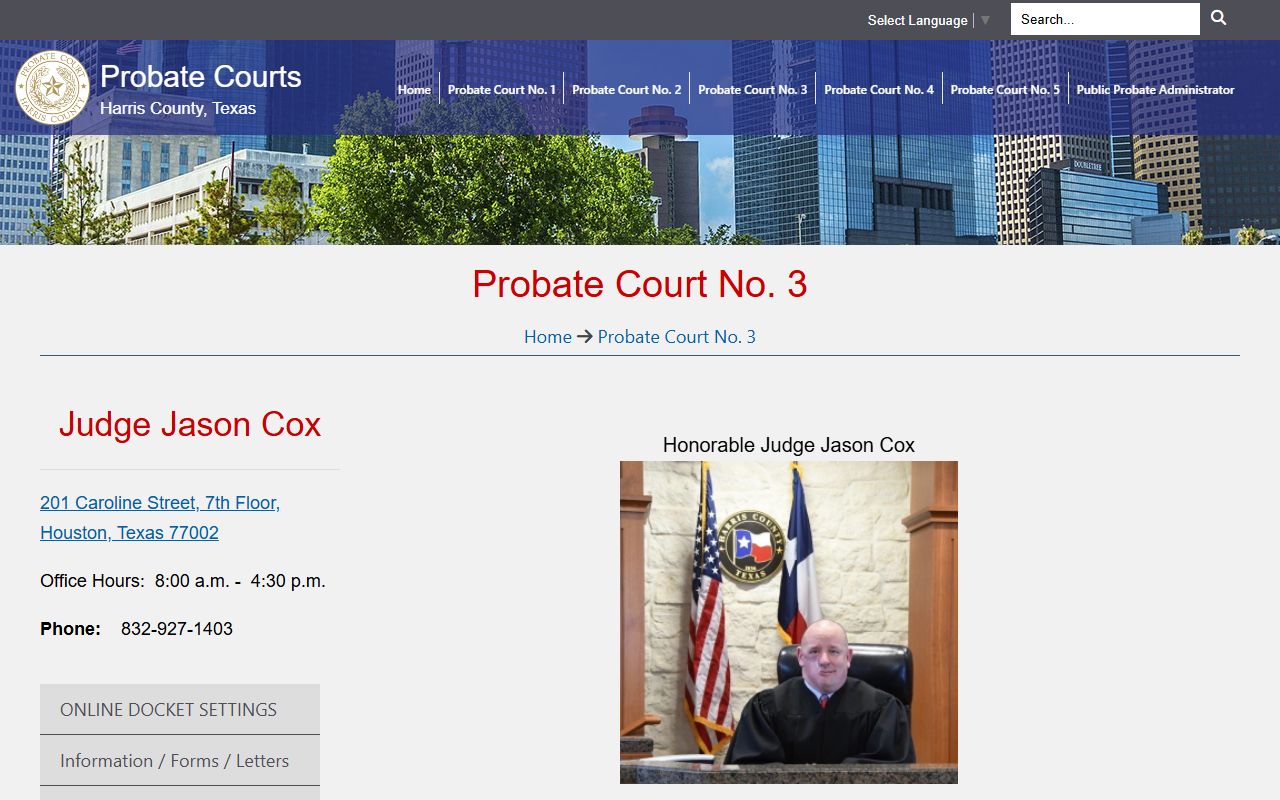
That page shows the kind of detail each court publishes, including office hours of 8:00 a.m. to 4:30 p.m. and staff contact links. The county also appoints a Public Probate Administrator who steps in for estates with no willing or able representative. Contact cards for the main probate location follow below.
Harris County Probate Courts
201 Caroline Street, 6th & 7th Floors
Houston, TX 77002
832-927-1401
Mon-Fri 8:00 a.m.-4:30 p.m.
Public Probate Administrator
Brandon Cofield
201 Caroline Street, Suite 607
Houston, TX 77002
832-927-1422
How Probate Works in Harris County
Texas offers more than one path through probate. Independent administration is common when a will authorizes it or the heirs agree, and it needs less court supervision. Dependent administration brings tighter court control over each step. For small estates, a small estate affidavit under Estates Code Chapter 205 may settle things without a full administration. A typical case moves through a clear set of steps from the first filing to final distribution.
- Determine whether there is a will and whether a formal administration is even needed.
- File an application in a Harris County probate court through e-filing or the clerk, with the filing fee set by the County Clerk fee schedule.
- The case is assigned to one of the five statutory probate courts.
- Provide the required notices and citations; some matters need posted or public notice.
- Attend the prove-up or hearing, where the court admits the will, determines heirship, or appoints a representative or guardian.
- The executor or administrator files the oath and any required bond, and letters testamentary or letters of administration are issued.
- Handle the inventory, appraisement, creditor notice, claims, taxes, real estate sales, and distributions.
- Contested matters may move on to discovery, mediation, trial, or appeal.
Guardianship cases add their own duties. A proposed guardian often must clear a criminal background check and complete training before the court will appoint them. Probate Court No. 3 links the JBCC background check, training, and registration steps for guardians. These extra hurdles exist to protect the ward.
Texas Probate Laws and Statutes
Two chapters of the Texas Estates Code shape most probate filings. Chapter 256 governs how wills are proved and admitted, including deadlines and the proof a court needs. Chapter 205 sets out the small estate affidavit, a simpler route for qualifying estates that skips full administration. Both are worth a quick look before a family decides which path to take.
Wills are admitted to probate under Texas Estates Code Chapter 256, which sets the rules for proving a will and the time limits that apply. The screenshot below is from that statute page.
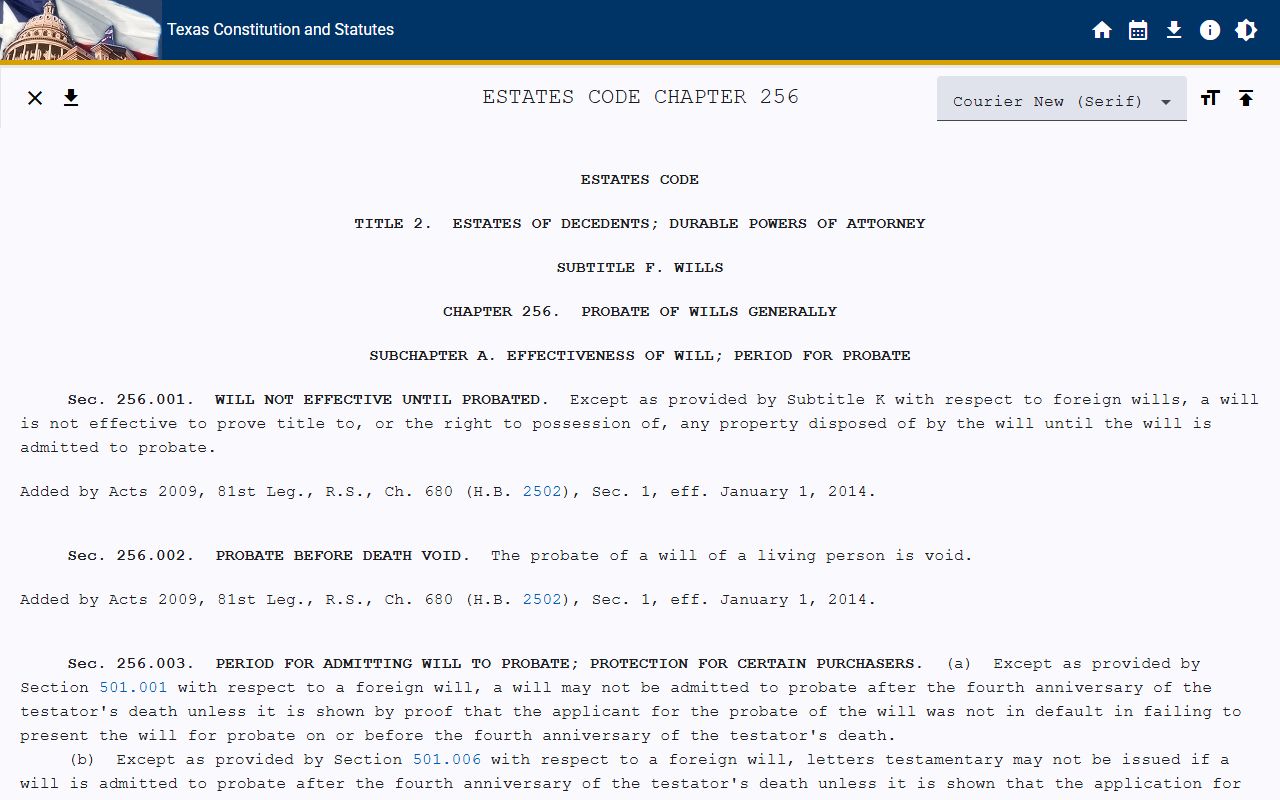
The chapter explains who may apply, what the court must find, and how a will becomes an official, public part of an estate file.
Smaller estates may avoid a full administration. The small estate affidavit lives in Texas Estates Code Chapter 205, which many families use when the estate is modest and there is no will. The image below comes from that page.
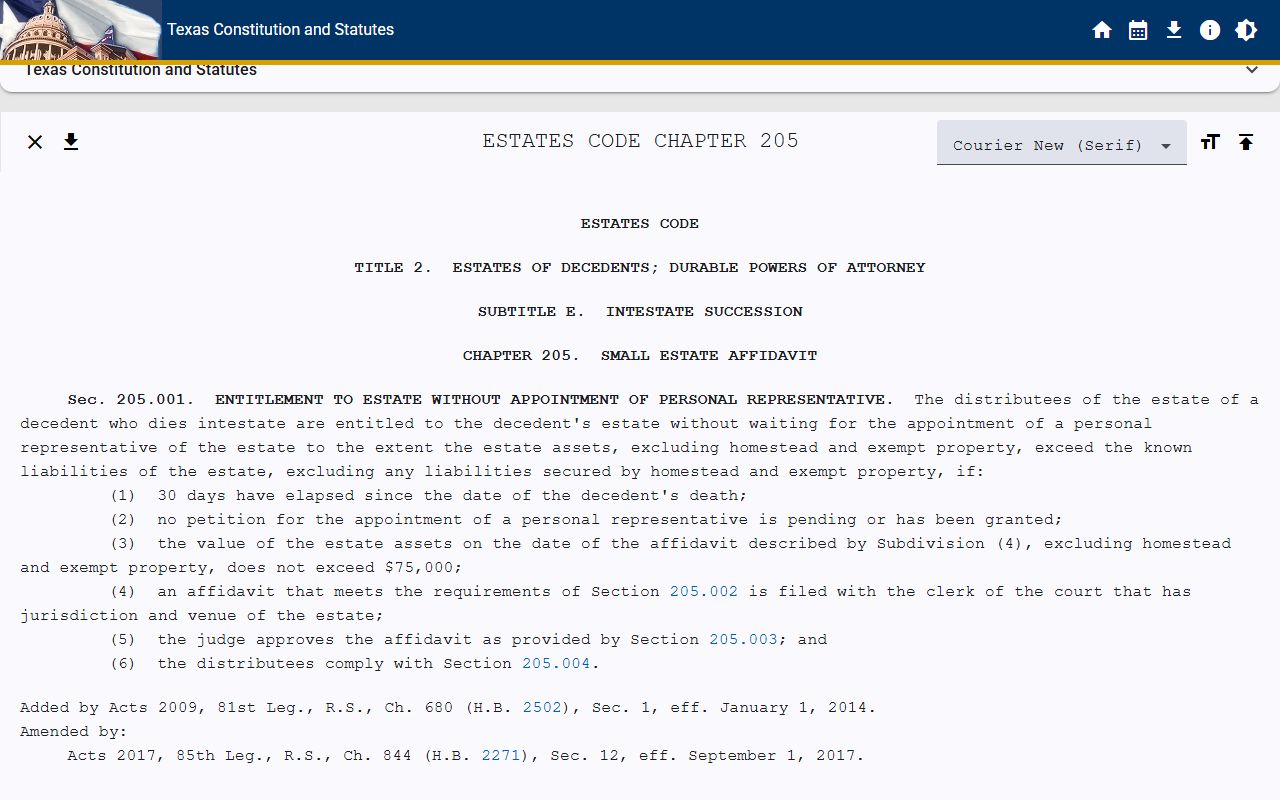
The affidavit has limits on estate value and on the kinds of property it can transfer, so read the chapter before you file one.
Harris County Probate Records Fees
Two kinds of fees show up in probate. There are filing fees to open a case, and there are copy fees to get records out of one. Filing fees for a probate application, guardianship, or letters come from the County Clerk fee schedule and depend on the case type and filings. The copy fees below are the County Clerk public-record fees that apply when you pull copies of probate documents.
| Item | Amount |
|---|---|
| Non-certified paper copy (per page) | $1 |
| Certified copy | $5 certification plus $1 per page |
| Records search fee | $5 per search |
| Probate case filing fee | Set by the County Clerk fee schedule |
A certified copy bought online is emailed and does not carry a raised seal. Some agencies want that raised seal, so plan an in-person or mailed request when one is required. The $5 search fee can be avoided when you give a file number, which is one good reason to pull the case number first. For marriage license and other copy fees, see the County Clerk page.
What Harris County Probate Records Show
A probate file tells the full story of an estate or guardianship. It opens with the application and, when there is one, the will. From there it builds out as the case moves. You will see who died, who applied, the heirs, and any appointed executor, administrator, guardian, or ward. The court number and judge are listed, along with the filing date and current case status.
The documents inside carry the real detail. Common filings include the will, the proof of death and facts, the oath, any bond, the inventory and appraisement of estate property, creditor claims, court orders, the letters that grant authority, and accountings. The case type is labeled too, whether it is probate of a will, a determination of heirship, an administration, a guardianship, or a mental health matter. Docket settings and orders round out the record.
- Case or file number and probate court number.
- Decedent, applicant, executor or administrator, heirs, guardian, and ward.
- Filing date, case type, and case status.
- Will, proof, oath, bond, and inventory documents.
- Court orders, letters, accountings, and docket settings.
Restricted Probate Records
Not every probate document is open. Mental health proceedings sit inside the probate courts, but their records are protected. Health and Safety Code Chapter 611 shields mental health treatment communications and records, so case details there may be kept from public view. Guardianship files can hold sensitive personal data about the ward, and some of that is restricted as well. Sealed documents in any probate case are not part of the public portal.
To reach a restricted record, a person usually has to be a party, an attorney, or someone the court allows. You ask the court that holds the file, show why you should have access, and wait for a ruling. Personal identifiers like Social Security and account numbers are redacted before release. For the wider list of confidential court records in the county, see the Harris County court records page.