
How to Search Harris County Court Records
Harris County splits court records by court level and by clerk. There is no single search box for every case. The main tool for district court files is the District Clerk's "Search Our Records and Documents" portal, run by District Clerk Marilyn Burgess. It covers civil, family, criminal, and juvenile district cases. Public case information stays free, but the site now asks you to set up a login before you can open court documents. The County Clerk runs a separate portal for county civil cases, probate, real property, marriage licenses, and assumed names.
Before you start, gather what you have. A full party name helps. A cause number helps more. You should also know roughly what kind of case it is, since that tells you which portal to open.
The District Clerk home page is the best starting point for district court files. The screenshot below comes straight from the Harris County District Clerk website.
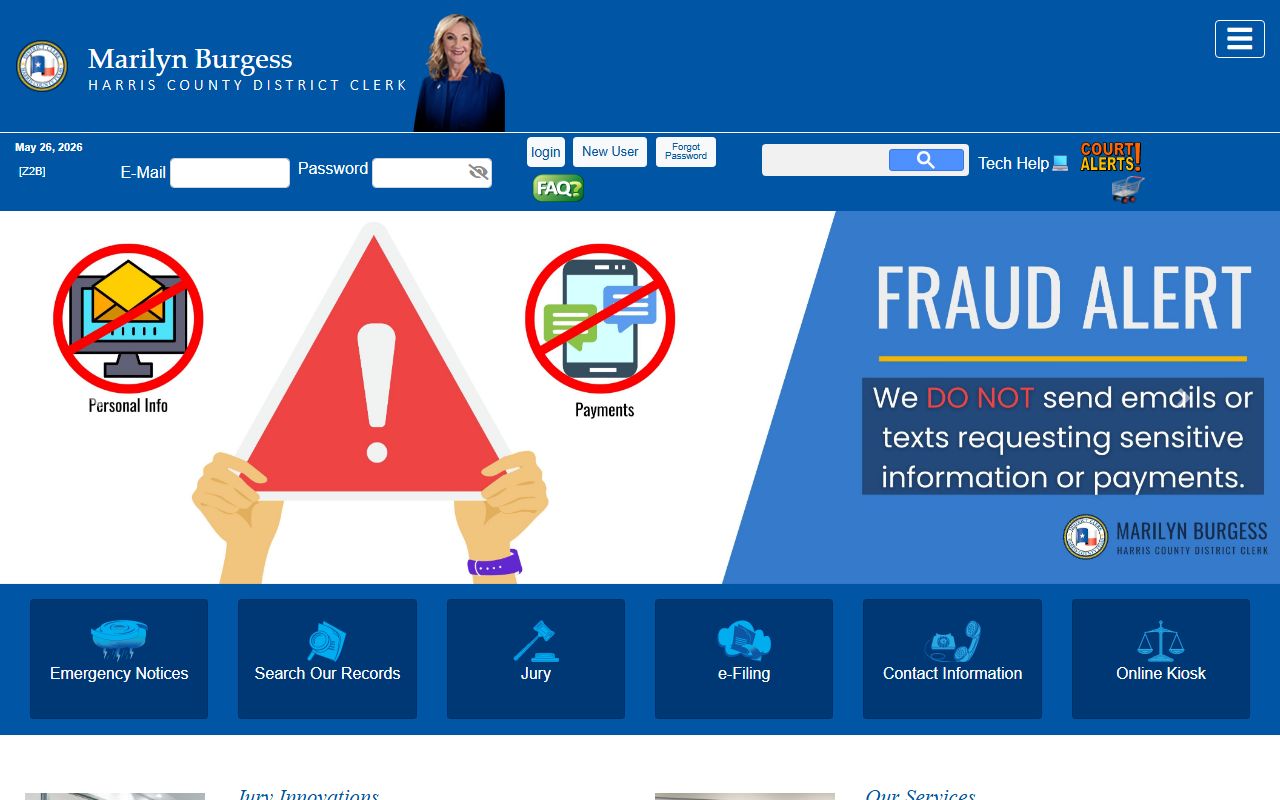
From that page you can reach party inquiry, docket search, background checks, trial judgments, and historical records. Each tool opens its own form with its own fields.
- Open the District Clerk portal and pick a search type, such as Party Inquiry for a name search.
- Enter the party name in "Last, First" form, or type a cause number if you have one.
- Set the court type to Civil, Criminal, or Family, then add a filed date range to narrow results.
- Review the case list, open the case, and read the docket entries and party details.
- Log in to view filed documents, or request a certified copy from the clerk if you need one for court.
For county civil, probate, and personal records, use the County Clerk Document Search Portal instead. For traffic and small claims, use the Justice of the Peace courts. City of Houston tickets go through Houston Municipal Courts, not the county system.
The Harris County Judicial System
Texas uses a layered court structure, and Harris County runs a large version of it. At the top sit two state high courts. The Supreme Court of Texas is the highest civil court. The Court of Criminal Appeals is the highest criminal court. Appeals from Harris County usually go first to the First Court of Appeals or the Fourteenth Court of Appeals, both based in Houston. Below those are the trial courts, where cases start and most records are made.
District courts handle felonies, high-value civil suits, family law, and juvenile matters. County courts at law take misdemeanors and many lower-dollar civil cases. Statutory probate courts handle estates, guardianships, and mental health proceedings. Justice courts and municipal courts handle Class C cases, traffic, small claims, and city tickets. The Texas Judicial Branch lists seven types of trial courts in all.
The Texas Judicial Branch site gives a clear overview of how these courts fit together. The image below is from the Texas Judicial Branch courts overview.
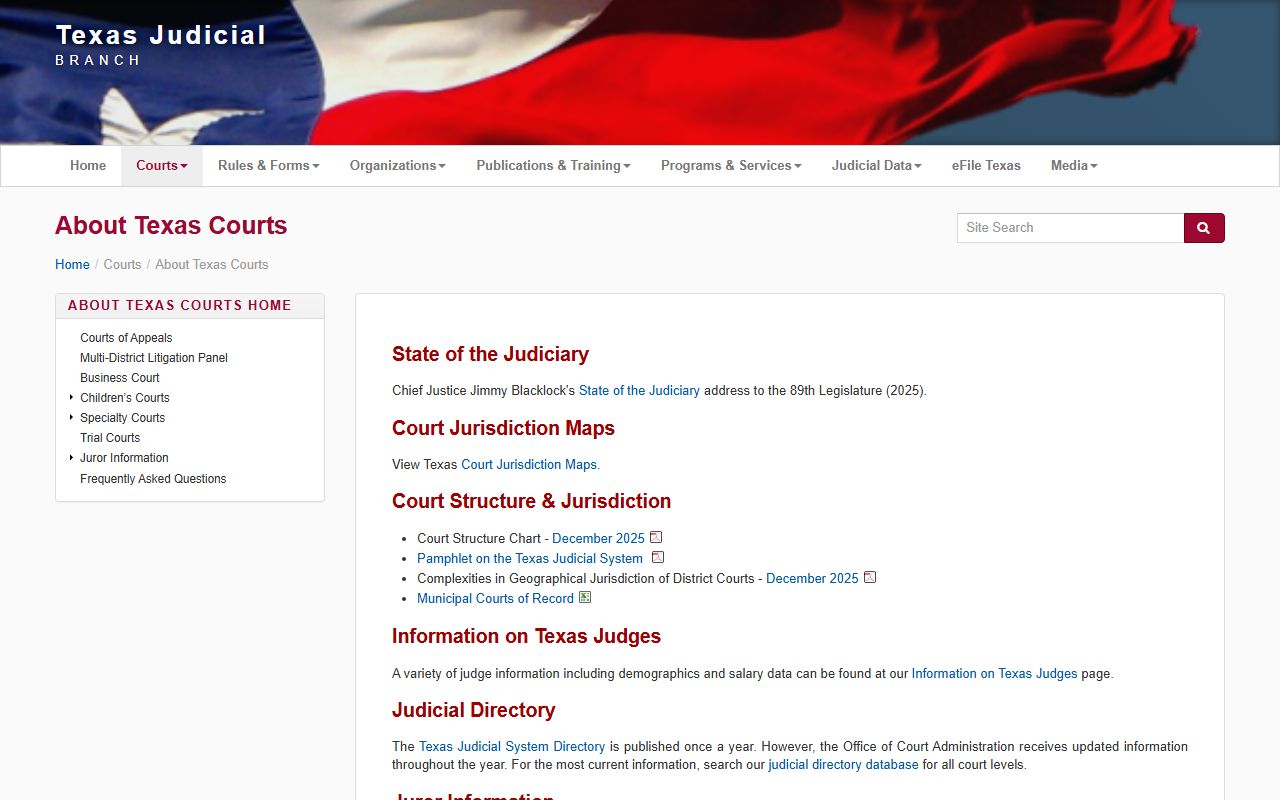
Because Harris County is so large, its district courts are specialized into civil, criminal, family, and juvenile benches. That split matters when you search, because the right clerk and the right portal depend on the case type.
Case flow: Justice Court › County Court › District Court › Court of Appeals
| Court | Jurisdiction | Case Types |
|---|---|---|
| District Courts | Felony and major civil | Felonies, high-value civil suits, divorce, custody, juvenile |
| County Courts at Law | Misdemeanor and lower civil | Class A and B misdemeanors, civil suits within county limits, JP appeals |
| Statutory Probate Courts | Probate and guardianship | Wills, estates, heirship, guardianship, mental health |
| Justice Courts | Class C and small claims | Traffic, small claims, evictions, tow hearings |
| Municipal Courts | City ordinance | City of Houston tickets and Class C city cases |
The county government also keeps a single landing page that links to all of these courts. It is a useful map when you are not sure where a case belongs, and it points to the Harris County courts directory.
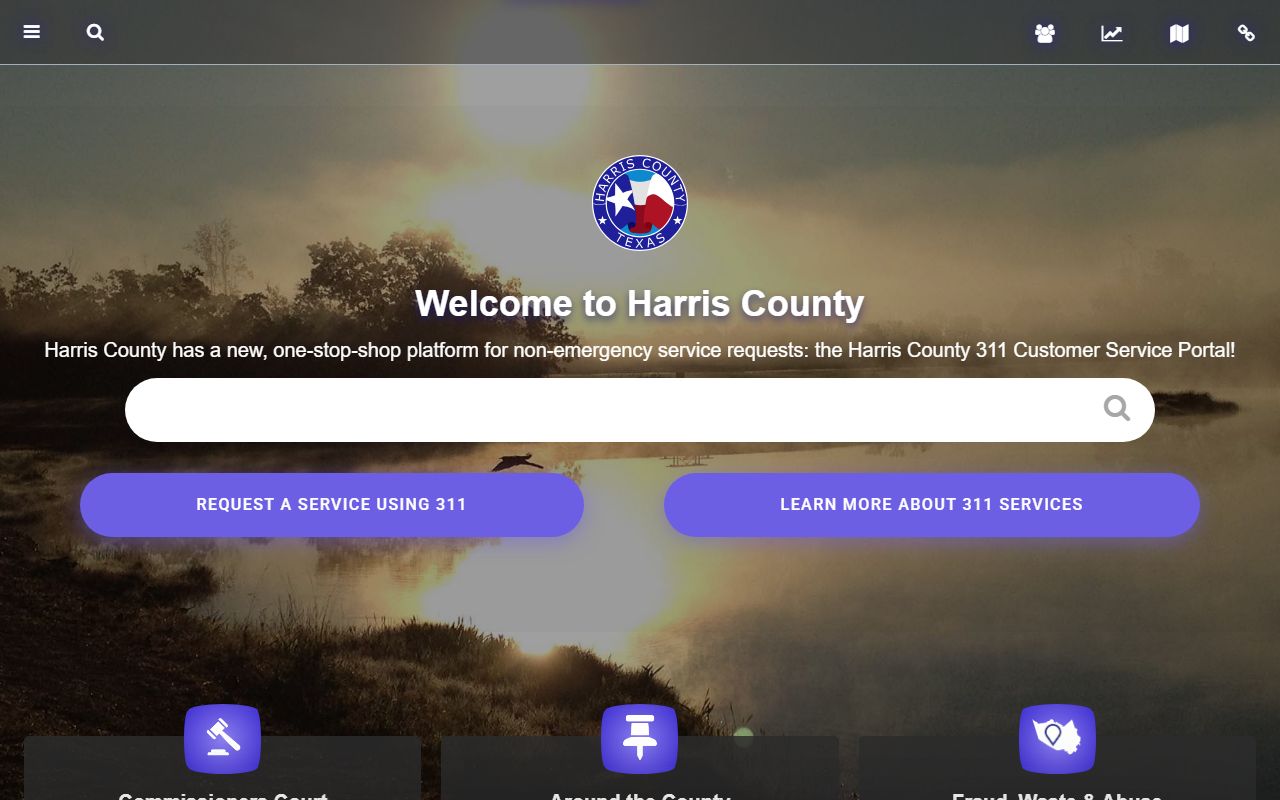
That directory links the District Clerk, County Clerk, JP courts, probate courts, and the District Attorney in one place.
District Clerk and County Clerk in Harris County
Harris County has a split clerk structure, and this trips up a lot of searchers. Two different elected offices keep court records. The District Clerk, Marilyn Burgess, keeps district court files for civil, family, criminal, and juvenile cases. The County Clerk, Teneshia Hudspeth, keeps county civil court files, probate records, marriage licenses, real property records, and assumed names. If you search the wrong office, you will not find your case.
The County Clerk also runs the official records portal for land, marriage, and personal records. You can view watermarked copies for free once you register, and buy certified or plain copies online. The image below is from the Harris County Clerk website.

Here is a quick way to tell the two offices apart.
| District Clerk | County Clerk |
|---|---|
| District court civil and family cases | County civil court at law cases |
| Felony criminal cases | Class A and B misdemeanor case files |
| Juvenile district matters | Probate, wills, and guardianship |
| Divorce and custody records | Marriage licenses and assumed names |
| Historical district court records | Real property and land records |
For more on each office, see the Harris County District Clerk page and the Harris County Clerk page.
Harris County Courthouses
Court operations sit across a downtown courthouse campus, not one building. The Harris County Civil Courthouse at 201 Caroline Street holds the District Clerk public counter, the County Clerk records departments, the Civil Courts at Law, and Probate Courts 1 through 4. Criminal county courts sit a few blocks away at 1201 Franklin Street. The jail and the Joint Processing Center cluster around San Jacinto and Baker streets. Probate Court No. 5 stands apart at 1115 Congress Street.
The Civil Courts at Law publish their court list, judges, and address online. The screenshot below comes from the Harris County Civil Courts at Law site.
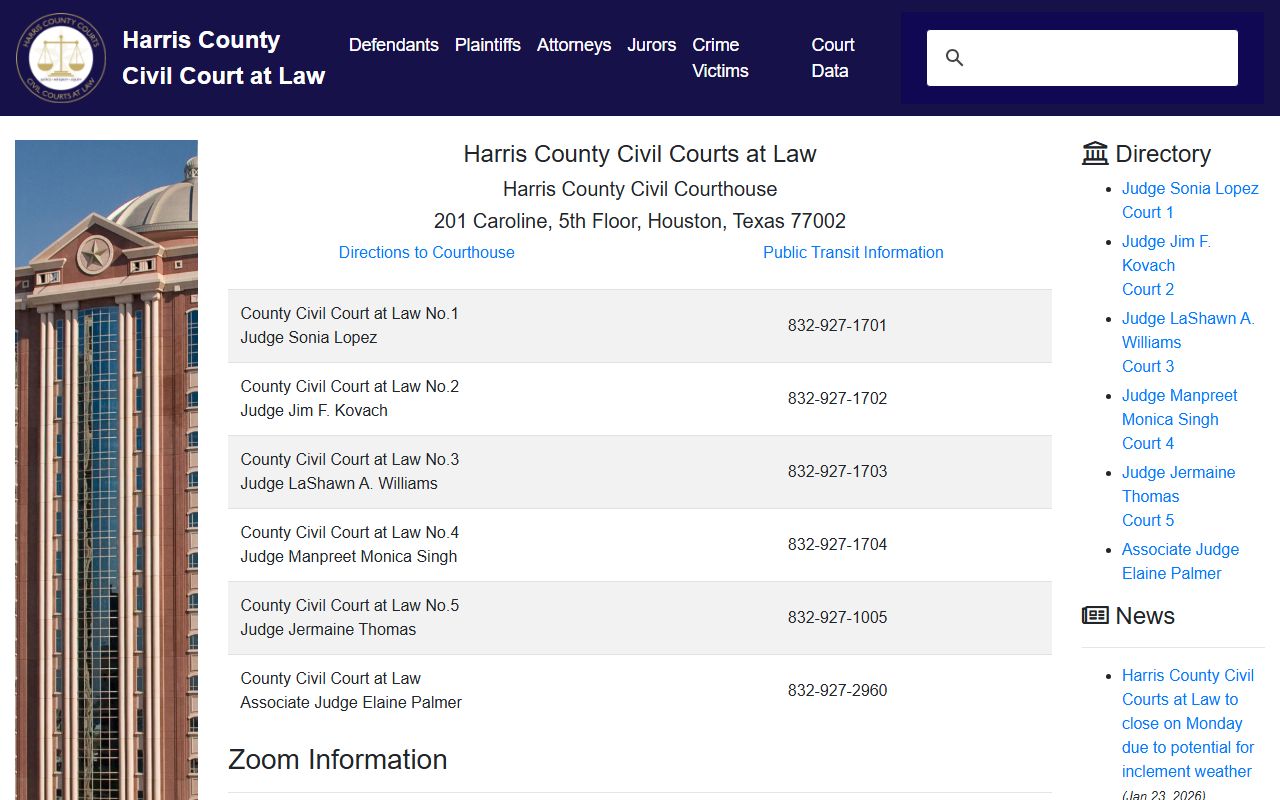
Confirm the exact courtroom or clerk department before you drive downtown. The wrong building can cost you an hour.
Harris County Civil Courthouse
201 Caroline Street
Houston, TX 77002
832-927-5800
Types of Court Records Available in Harris County
Harris County court records cover a wide range of case types. Some are open to anyone. Others are sealed by statute. The court that handled a case sets where its records live and how you reach them. Felony and major civil files run through the District Clerk. Misdemeanor and probate files run through the County Clerk and the county courts.
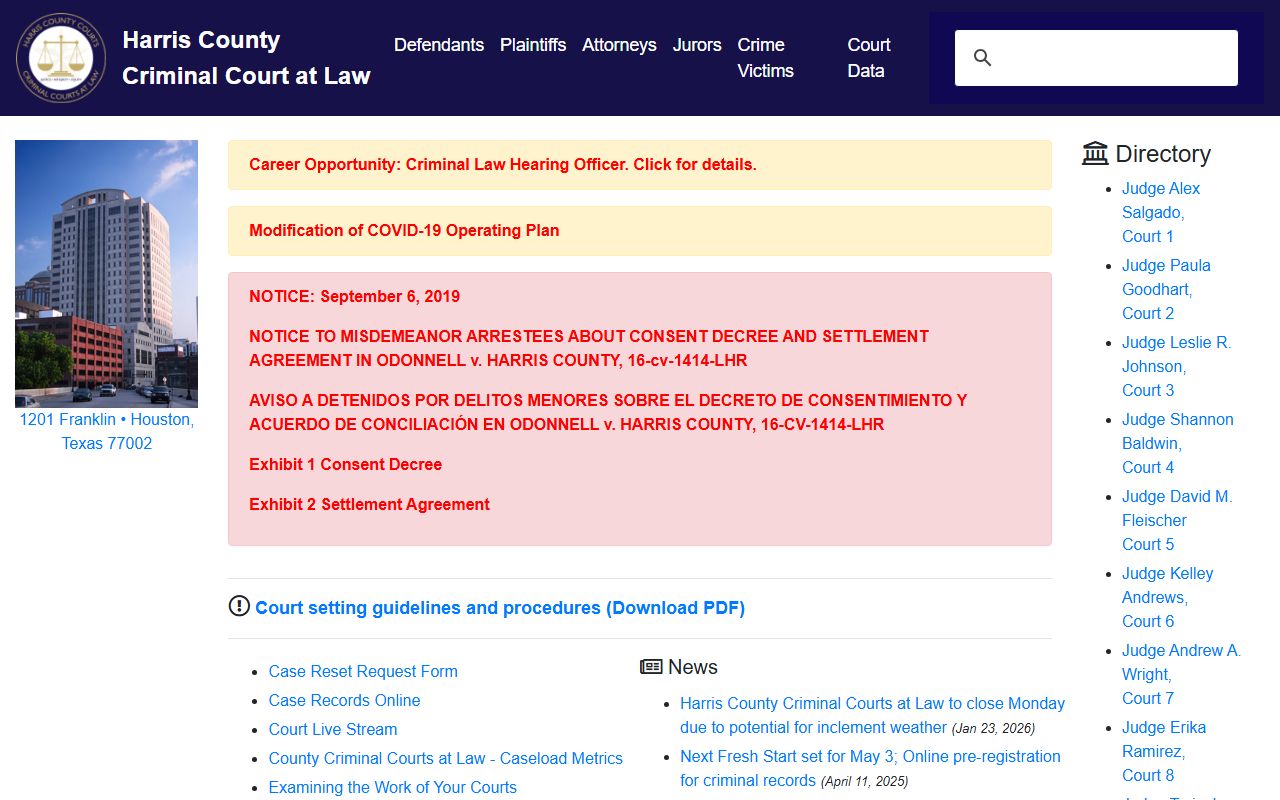
The 16 County Criminal Courts at Law handle Class A and B misdemeanor cases. Their site posts schedules, case records, and local rules, as shown in the image from the Harris County Criminal Courts at Law page.
- Civil records - lawsuits, judgments, liens, and tax cases in the district and county courts.
- Criminal records - felony cases through the District Clerk and misdemeanors through the county courts.
- Family and divorce records - divorce, custody, and support cases; document access is limited.
- Probate records - wills, estates, and guardianships in the five statutory probate courts.
- Traffic records - Class C citations in the justice courts and the city municipal courts.
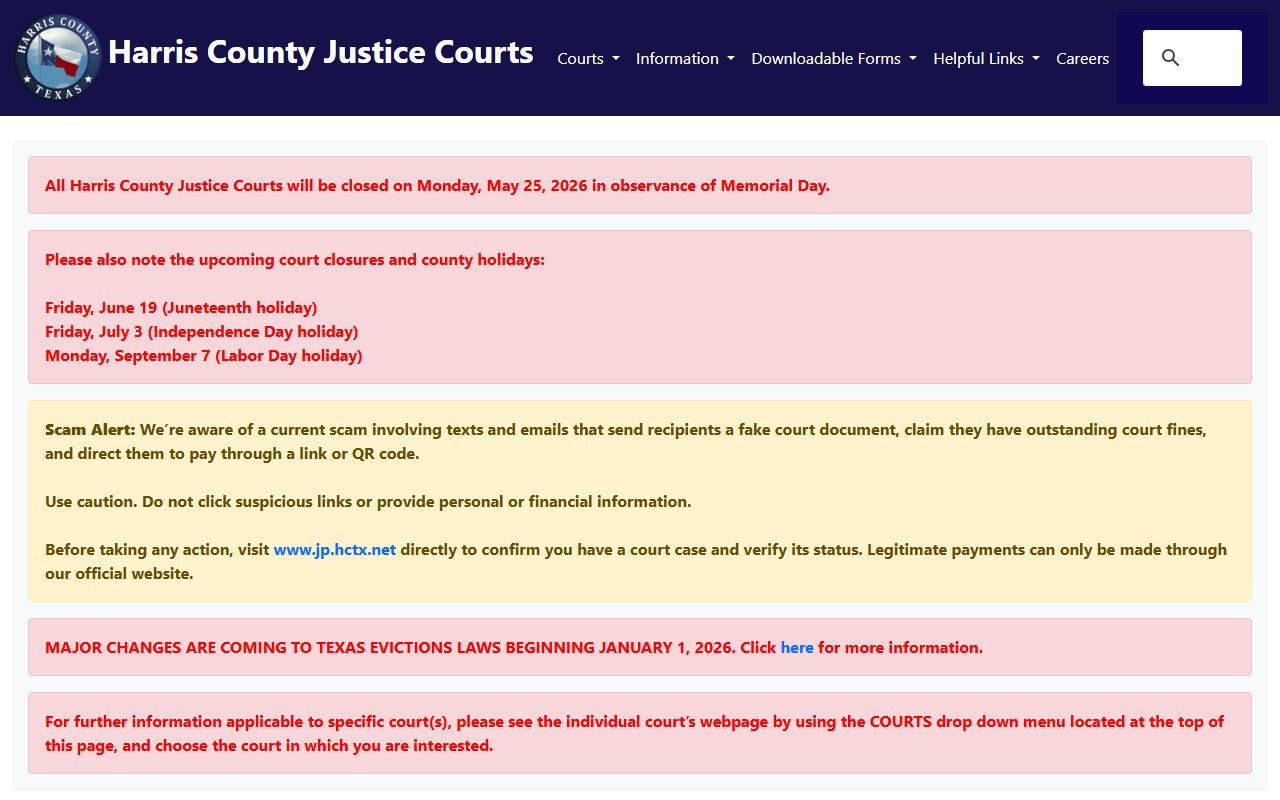
Traffic and small claims cases sit in a different system. The 16 Harris County Justice of the Peace courts handle Class C citations, evictions, and small claims across the county. Their homepage links case lookup, citation payment, and driver safety course options, as shown in the image from the Harris County Justice of the Peace courts.
A JP case stays in its precinct court, so it will not show up in the district or county clerk portals.
For the full breakdown of each type and how to pull it, see the Harris County court records page.
What Harris County Court Records Show
A court record is more than a name. Each file holds a set of fields that tell the story of a case. The District Clerk Party Inquiry tool lets you search by name and then opens case details, parties, court costs, and the file location. Below is the set of fields you use to run that name search.
| Field Label | Type | Required | Notes / Format |
|---|---|---|---|
| Party Name | Text | Yes | Format as "Doe, Jane"; choose Starts With or Contains |
| Party Role | Dropdown | No | All, Defendant, or Plaintiff |
| Filed Date Range | Date range | No | MM/DD/YYYY to MM/DD/YYYY |
| Case Status | Dropdown | No | Active, Disposed, Dismissed, and many more |
| Court Type | Dropdown | No | Civil, Criminal, or Family |
| Case/Offense Type | Dropdown | No | Loads after you pick a court type |
Once you open a case, you will see the cause number, the filing date, the court and case status, the parties and their roles, the docket entries, and any court costs. Filed documents can be viewed after you log in. Family documents are held back from public review even when the case itself is listed.
Public Access Laws for Harris County Court Records
Texas treats court files and general government records under different rules. The Texas Public Information Act covers records held by government bodies, but access to judicial records runs through court rules instead of a plain open-records request. In practice, that means you use the clerk search portals for filed court documents, and you save a Public Information Act request for county records that are not already online. Most court records are open unless a statute or a judge makes them confidential.
Key Statutes:
Texas Government Code § 552.021 - public information must be open during normal business hours at county offices.
Texas Government Code § 552.0035 - access to court records is set by Supreme Court rules, not the standard request process.
Texas Code of Criminal Procedure Chapter 55 - covers who may clear an arrest or case from public records.
Texas Government Code Chapter 411 - sets the rules for sealing criminal history through an order of nondisclosure.
For the broader county records framework, including land, marriage, and business filings, see the Harris County public records page.
Records That Are Restricted or Confidential
Not every Harris County record is open to the public. Juvenile case files are restricted under the Family Code. Adoption records are confidential. Mental health proceedings are protected. Sealed civil records, expunged criminal records, and records under an order of nondisclosure are kept from public view by law. Family case documents are held back from the District Clerk public search even when the case is listed.
To see a sealed record, a person usually has to be a party, an attorney, or someone the court allows. You petition the court that holds the file, show why you should have access, and wait for a ruling. Personal data such as Social Security numbers and account numbers is redacted before release.
Specialty Courts in Harris County
Harris County runs problem-solving courts that focus on treatment rather than jail. These programs pull together judges, prosecutors, defense lawyers, community supervision officers, and treatment providers. They show up as docket types in the District Clerk search, so you may see them in your results.
The Mental Health Court targets felony clients with serious mental health needs as a sentencing alternative. The DWI Court works on the thinking and habits behind impaired driving, with treatment and close judicial monitoring. The Veterans Court works with the Veterans Administration to connect former service members to care. The Community Supervision and Corrections Department lists these and other programs, such as competency restoration and the SIPS docket.
Harris County Sheriff and Jail Information
The Harris County Sheriff's Office, led by Sheriff Ed Gonzalez, runs the county jail and the largest sheriff's office in Texas. It serves more than 4.1 million residents across 1,788 square miles. The jail campus sits downtown near the criminal courthouse, and people who are released exit the Joint Processing Center at 700 North San Jacinto Street. The Sheriff's Office site links inmate search, visitation, bonding, mail, and warrants in one place.
The Sheriff's home page is the gateway to all of those jail tools. The screenshot below is from the Harris County Sheriff's Office website.

For the roster lookup and booking details, see Harris County inmate records. For active warrants, see warrant records, and for jail counts, see jail population data.
Marriage, Divorce, and Probate Records
The County Clerk issues marriage licenses and keeps the marriage record index. Divorce, on the other hand, is a district court matter handled through the District Clerk, since divorce is filed as a family case. Probate runs through the five statutory probate courts, with records held by the County Clerk. The probate courts post forms, rules, and dockets online, as shown in the image from the Harris County Probate Courts site.
For details, see marriage and divorce records and probate records. A few probate terms come up often.
- Testator
- The person who made the will.
- Executor
- The person named in a will to settle the estate.
- Intestate
- Dying without a valid will, which sends the estate to state succession rules.
- Guardianship
- A court-ordered arrangement to care for a minor or an incapacitated adult.
Harris County Court Records Fees
Copy fees are set by each office. The County Clerk posts its copy fees online. The District Clerk publishes separate civil and family and criminal fee schedules as PDF files. The numbers below are the County Clerk public-record copy fees.
| Item | Amount |
|---|---|
| Non-certified paper copy (per page) | $1 |
| Certified paper copy | $5 certification plus $1 per page |
| Non-certified electronic copy | $1 for up to 10 pages, then 10 cents per page |
| Records search fee | $5 per search |
| Map or condo record (non-certified, per page) | $10 |
A certified copy you buy online is emailed and does not carry a raised seal. Some agencies still want the raised seal, so plan an in-person or mailed request when a seal is required.
How to Interpret Harris County Court Records
Court files use shorthand. A cause number is the case number the county assigns to a file. A docket is the running log of settings and filings. A disposition is the final outcome of a charge or case. An arrest is not a conviction. A charge only means the state filed a case. A conviction means a guilty plea or a finding of guilt by a court.
Status labels also matter. "Disposed" means the case has reached a final outcome. "Active" means it is still moving. "Dismissed with prejudice" cannot be refiled, while "dismissed without prejudice" can be brought again. Read the disposition before you assume what a record means.
Accuracy and Record Limitations
Online records lag behind the courtroom. New filings can take a day or more to appear, and real property images can take one to two business days after recording. Data depends on what staff entered, so a typo in a name can hide a case.
Note: Confirm any case detail with the clerk's office that holds the file before you rely on an online record for a legal or financial decision.
History of Harris County Courts
Harris County records reach back to the Republic of Texas. The County Clerk says land records date from 1836 to the present. The District Clerk holds district court documents from 1837 forward, and keeps files from 1837 to 1925 in the Charles Bacarisse Historical Documents Room in the Civil Courthouse. A Naturalization Records Index covers 1837 to 1913. The 1910 Harris County Courthouse still stands as a downtown landmark, and the county created its Archives in 2002 to preserve old records.
Frequently Asked Questions
How do I find someone in the Harris County Jail?
Use the Sheriff's Office inmate search portal, linked from the Jail Information page. You can search by name or by the Sheriff's personal number. If the online data is unclear, call incarcerated person information at 713-755-5300. The Offense Inquiry tool also shows jail status, the next court setting, and release timing when you have a case or offense number.
How do I search Harris County district court records?
Use the District Clerk "Search Our Records and Documents" portal. Party Inquiry searches by name, while Docket Search finds court settings. You can view public case information for free, but you set up a login to open filed documents. The portal returns Harris County data only, not federal cases, other counties, or JP and municipal tickets.
How much is a Harris County marriage license?
The County Clerk lists a fee of $81 when at least one applicant shows valid Texas residency proof, and $181 without that proof. An informal marriage declaration costs $46. A Twogether in Texas premarital course can cut the fee by up to $60 and waive the 72-hour wait. Certified copies ordered at filing are $6 each.
More on the Harris County Court Records FAQ page.