
Texas Public Information Act and Harris County Records
The Texas Public Information Act is Government Code Chapter 552. It sets the rule that people may see information kept by a government body unless a law says otherwise. The act covers county offices like the clerk, the sheriff, and the district attorney. It does not cover everything, though. There is one big split that matters in Harris County, and it trips up a lot of searchers. Court case files follow a different path than general county records.
Here is the key point. Texas Government Code § 552.0035 says access to court records is set by rules adopted by the Supreme Court of Texas, not by a plain open-records request. So a filed case file goes through the clerk's court-copy process. A general county record that is not already online can go through a Public Information Act request. Use the right channel and the request moves faster.
Most county records stay open to the public. Government Code § 552.021 says public information must be available during normal business hours. Section 552.022 lists categories that stay public unless a law makes them secret, such as completed reports, contracts, and final opinions. Anyone can ask. You do not need to give a reason, and you do not need to live in Texas.
What Records the Harris County Clerk Keeps
The County Clerk, Teneshia Hudspeth, holds the bulk of the public records that people search in Harris County. This office is not the same as the District Clerk, which keeps district court case files. The County Clerk keeps land and property records, official maps and condo plats, marriage licenses, assumed name certificates (also called DBAs), UCC filings, and a range of miscellaneous personal records. It also keeps case files for the County Civil Courts at Law, the Probate Courts, and Commissioners Court.
Land records here run deep. The County Clerk says Harris County real property records date from the Republic of Texas in 1836 to the present. That is nearly two centuries of deeds, liens, and plats. The County Clerk public records page is the main hub for these documents, and it lays out the record types and copy fees in one place. The screenshot below comes from the County Clerk public records page.
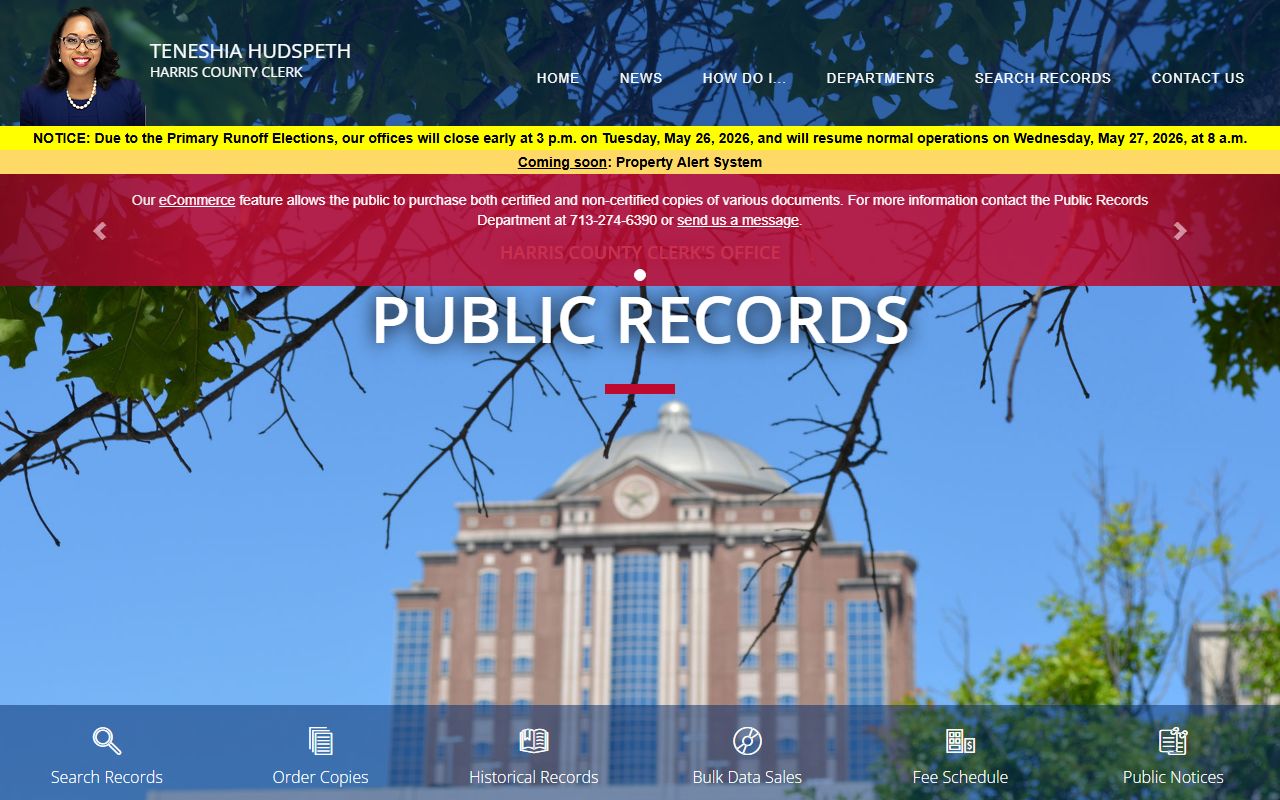
From that page you can reach land records, marriage records, assumed names, copy fees, historical records, and the county archives. The common record types the public asks for break down like this.
- Real property records - deeds, liens, mortgages, releases, and other land filings from 1836 forward.
- Maps and condos - recorded plats, subdivision maps, and condominium declarations.
- Marriage licenses - ceremonial and informal marriage filings issued in Harris County.
- Assumed names (DBAs) - business name filings for sole owners and partnerships.
- UCC filings - Uniform Commercial Code financing statements.
- Miscellaneous personal records - powers of attorney, military discharge filings, and other personal documents.
Registered users can view watermarked copies free where an image exists. The Real Property Department handles the land side and the recording counter in person. The image below is from the County Clerk real property department page.
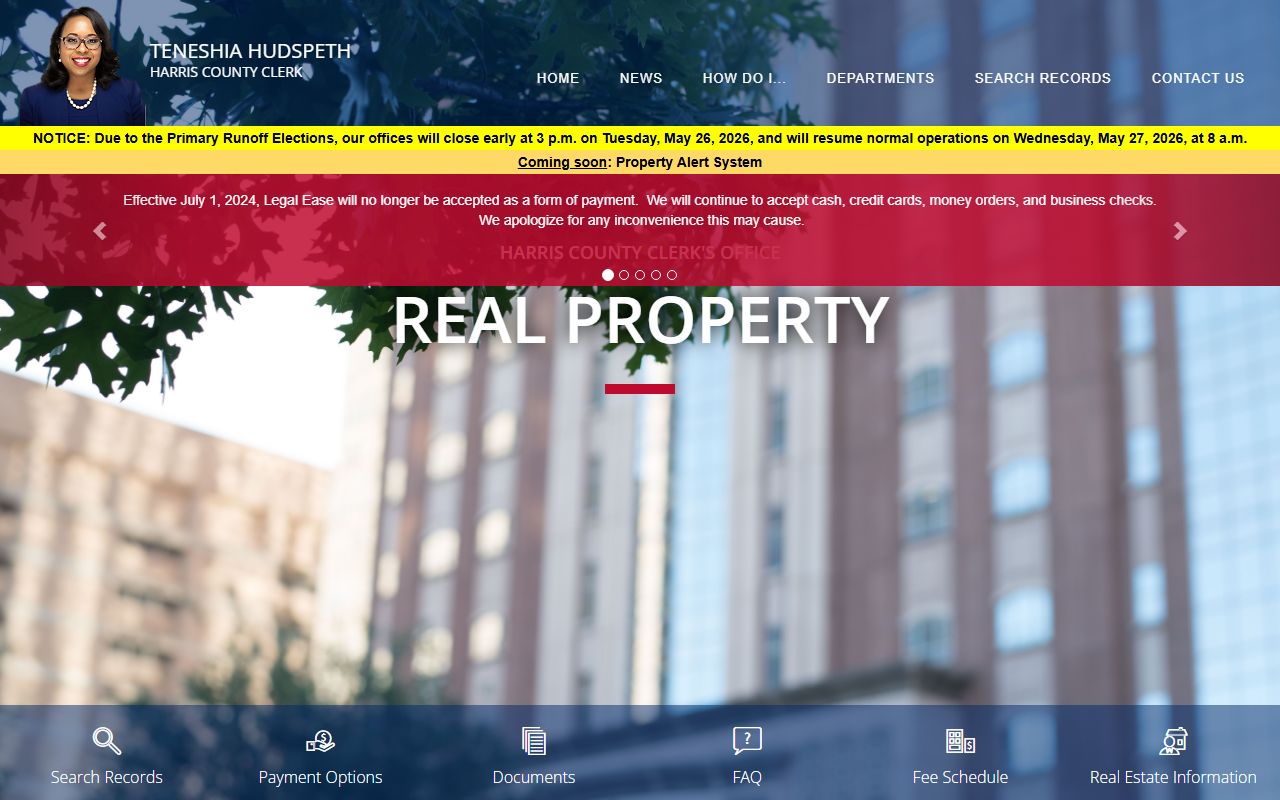
That department sits at 201 Caroline, Suite 320, and you can reach it at 713-274-8680. Hours run Monday through Friday, 8:00 a.m. to 4:30 p.m.
How to File a Harris County Public Records Request
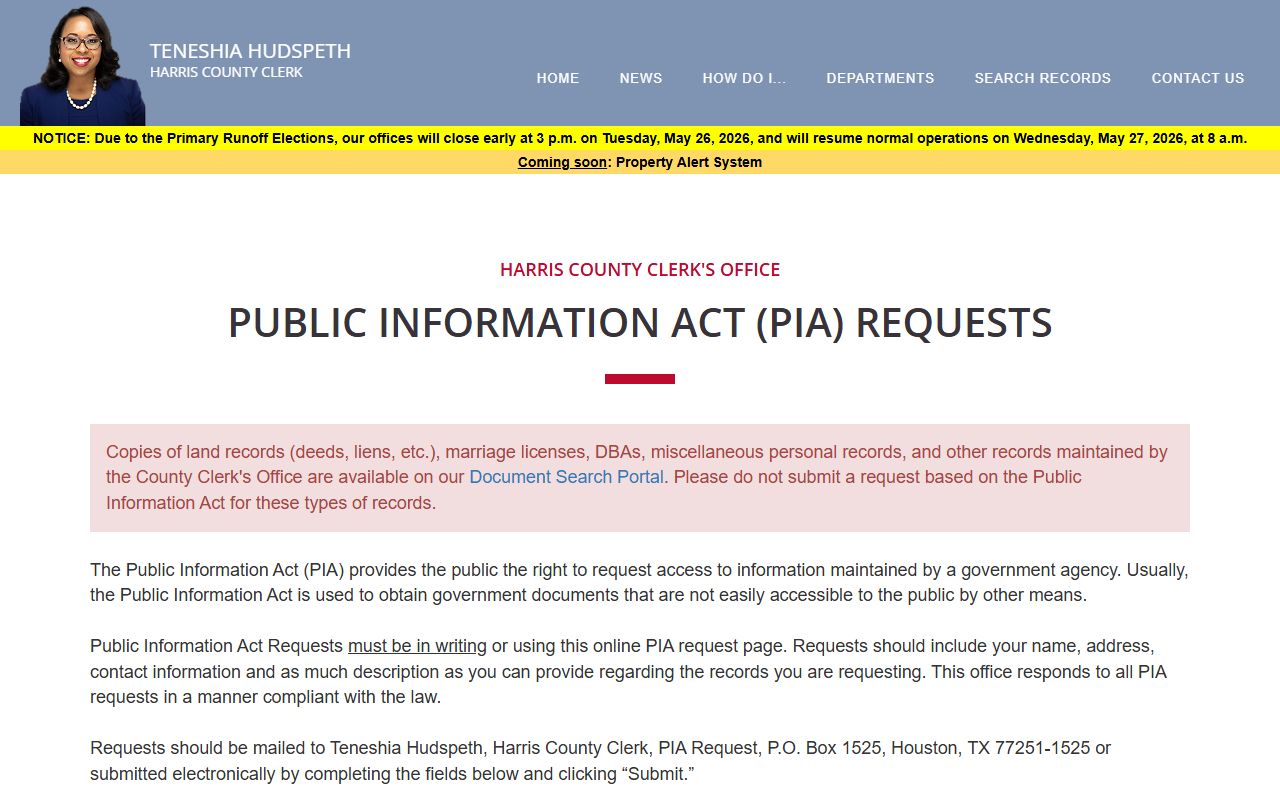
Most land, marriage, and DBA records do not need a formal request at all. You can search and buy copies through the County Clerk Document Search Portal once you set up an account. A Public Information Act request is for county records that are not already online or sold through the portal. The County Clerk says PIA requests should not be used for land records, deeds, liens, marriage licenses, DBAs, or personal records that the portal already provides. For those, use the copy and order process instead.
When you do need a written request, put it in writing and address it to the right office. Personal and property record requests go to the Public Records team. A request must include your name, address, contact details, and a clear description of the records you want. The County Clerk PIA page explains when to use a formal request versus the document portal. The screenshot below is from the County Clerk Public Information Act request page.
Follow these steps to file a request the right way.
- Pick the right office. Court case files go through the clerk's copy process, not a PIA request. County records that are not online go to the County Clerk Public Records team.
- Describe the records clearly. Give names, a date range, and a file number or film code if you have one. A file number or film code lets the office skip the search fee.
- Submit your request. Mail it to Teneshia Hudspeth, Harris County Clerk, Attn: Public Records, P.O. Box 1525, Houston, TX 77251. You can also fax 713-755-4977 or email ccoinfoFM@cco.hctx.net.
- Wait for the response. The office reviews the request, finds the records, and tells you the cost. Some records can be withheld by law.
- Pay the fee and get your records. Choose your delivery method, settle any copy or certification charge, and receive the documents.
Questions about a public records request can go to the Public Records Department at 713-274-6390. For personal records like DBAs and marriage filings, the Personal Records Department sits at 201 Caroline, Suite 330, phone 713-274-8686.
Harris County Records Request Form Fields
A County Clerk copy or order request gathers a set of details before staff can pull and price the records. Knowing the fields ahead of time speeds things up. The table below shows what the County Clerk public-record order process asks for, drawn from the office's copy request and routing instructions.
| Field | Required | Notes |
|---|---|---|
| Record type | Yes | Real property, maps, condos, marriage license, assumed names, UCC, or miscellaneous personal records. |
| Requester name and contact | Yes | Name, address, phone, and email for written mail, fax, or email requests. |
| Delivery method | Yes | Fax, email, postal mail, or in-person pickup at any annex. |
| File number or film code | Fee-relevant | Optional, but if left blank a $5 search fee applies per search. |
| Payment | Yes | Copy and certification charges due before release; 4% surcharge on a major credit card used without the cardholder present. |
| Certification | Optional | A certified copy adds the $5 certification fee or the map and condo certified page rate. |
| Department routing | Yes | Public Records, Civil Court at Law, and Probate Court requests use different fax, email, and mail routing. |
Department routing matters. A probate record request and a land record request go to different mailboxes. Send each request to the team that holds the file, or it can bounce back.
Response Timelines for Records Requests
Under the Texas Public Information Act, a government body must promptly produce public records or seek a ruling if it believes a record can be withheld. Many county records that are already public come back quickly. A simple copy order through the portal can be filled the same day, since you view and buy the document on your own. A written request takes longer because staff must search, review, and price the records.
If an office thinks a record is confidential, it can ask the Texas Attorney General for a ruling before releasing or withholding the file. That step adds time. Keep a copy of your request and the date you sent it. A clear, narrow request comes back faster than a broad one.
Harris County Public Records Fees
The County Clerk posts its copy fees online. What you pay depends on the format, whether you want certification, and whether you give a file number. A file number or film code lets the office skip the $5 search fee. The figures below are the County Clerk public-record copy fees.
| Item | Amount |
|---|---|
| Non-certified paper copy (per page) | $1 |
| Certified paper copy | $5 certification plus $1 per page |
| Non-certified electronic copy | $1 for up to 10 pages, then 10 cents per page |
| Records search fee | $5 per search (waived with a file number or film code) |
| Map or condo record (non-certified, per page) | $10 |
| Major credit card surcharge | 4% when the cardholder is not present |
A certified copy you buy online is emailed and does not carry a raised seal. Some offices still want the raised seal. When a seal is required, plan an in-person or mailed request instead.
Note: Give a file number or film code on a copy request when you can, since it waives the $5 search fee that applies when staff must look up the record for you.
Harris County Records That Are Exempt
Not every record is open. The Public Information Act lists exceptions, and other laws make whole categories confidential. Personal data is the most common thing held back. Social Security numbers, financial account numbers, and access device numbers are redacted before release. Government Code § 552.136 protects credit card, debit card, and access device numbers found in clerk and court files.
Law enforcement and court rules also shield certain records. Government Code § 552.108 lets agencies withhold some law enforcement and prosecution information when release would interfere with a live case. Section 552.130 protects Texas motor vehicle records, including driver license and registration data, which matters for traffic and driver record requests. Juvenile files, adoption files, sealed civil records, and mental health proceedings are confidential under separate statutes.
A few legal terms come up a lot in public records work.
- Redaction
- Removing confidential details, such as a Social Security number, while leaving the rest of the record open.
- Certified copy
- A copy the clerk attests is a true copy of the record, often needed for legal or official use.
- Film code
- A reference code that points to a recorded document, used to skip the search fee on a copy request.
Searching Harris County Business and Personal Records
Assumed name records show who is behind a business that uses a trade name. People search them to check a vendor, settle a dispute, or start a company under a name that is not already taken. The County Clerk runs an online assumed name search that lets you look up a DBA by business name or owner. The screenshot below is from the County Clerk assumed name search.
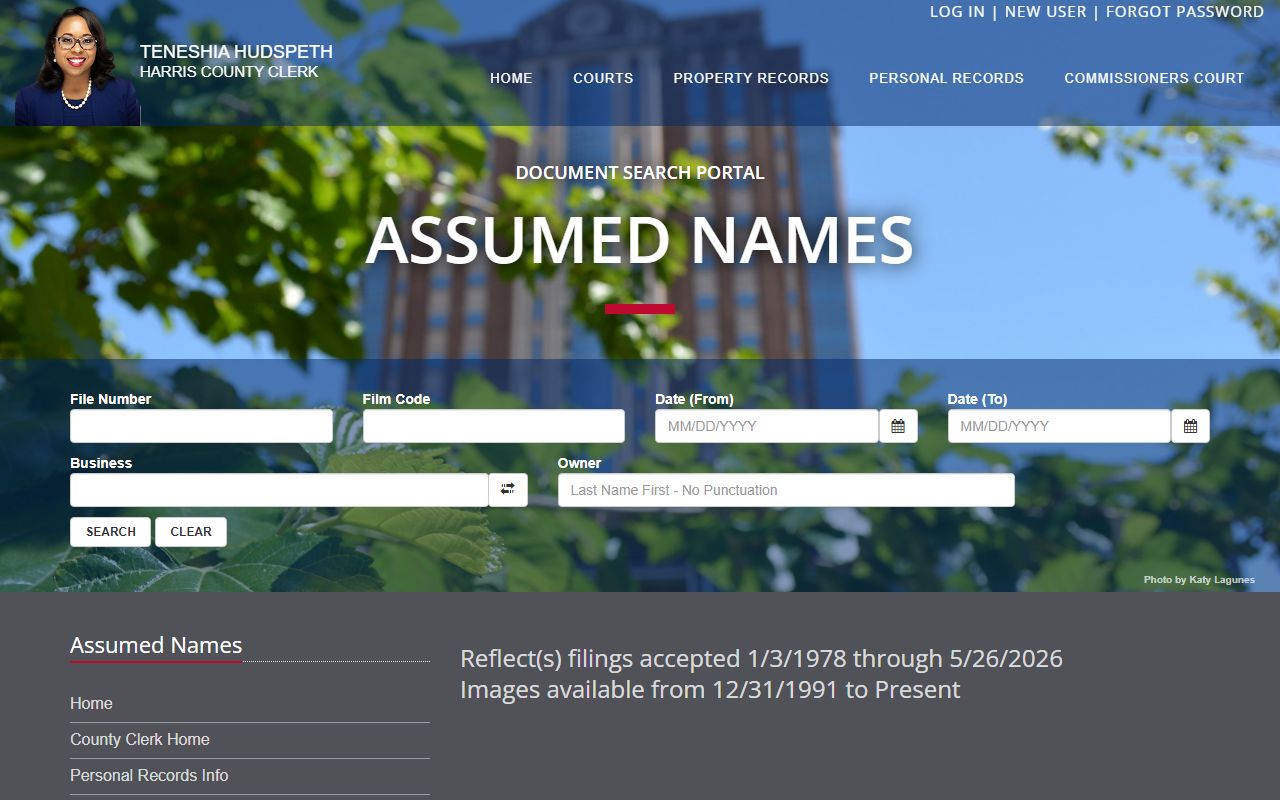
The same document portal holds UCC filings, military discharge records, powers of attorney, and other personal documents. Access to military discharge records is limited by law, so not every DD-214 filing is open to the general public. For most other personal records, a registered account lets you view a watermarked image free where one exists, then buy a clean or certified copy.
Court Records Versus County Public Records
The split between court files and general county records is the single most useful thing to understand here. Texas separates the two on purpose, and each follows its own access path. Government records flow through the Public Information Act. Court files flow through court rules and the clerk's copy process. The table below lays out the difference.
| Point | County public record | Court case file |
|---|---|---|
| Governing law | Public Information Act, Gov Code Ch. 552 | Supreme Court rules, per Gov Code § 552.0035 |
| Example records | Deeds, maps, DBAs, UCC, contracts | Civil, family, criminal, and probate filings |
| How to access | Document portal or a written PIA request | Clerk search portal and certified copy order |
| Main office | County Clerk Public Records | District Clerk or County Clerk court division |
To learn what the broad framework means for case files, see the Harris County court records page. For the clerk that holds district court files, see the District Clerk page, and for the office behind these public records, see the County Clerk page.
The Texas Open Records Framework
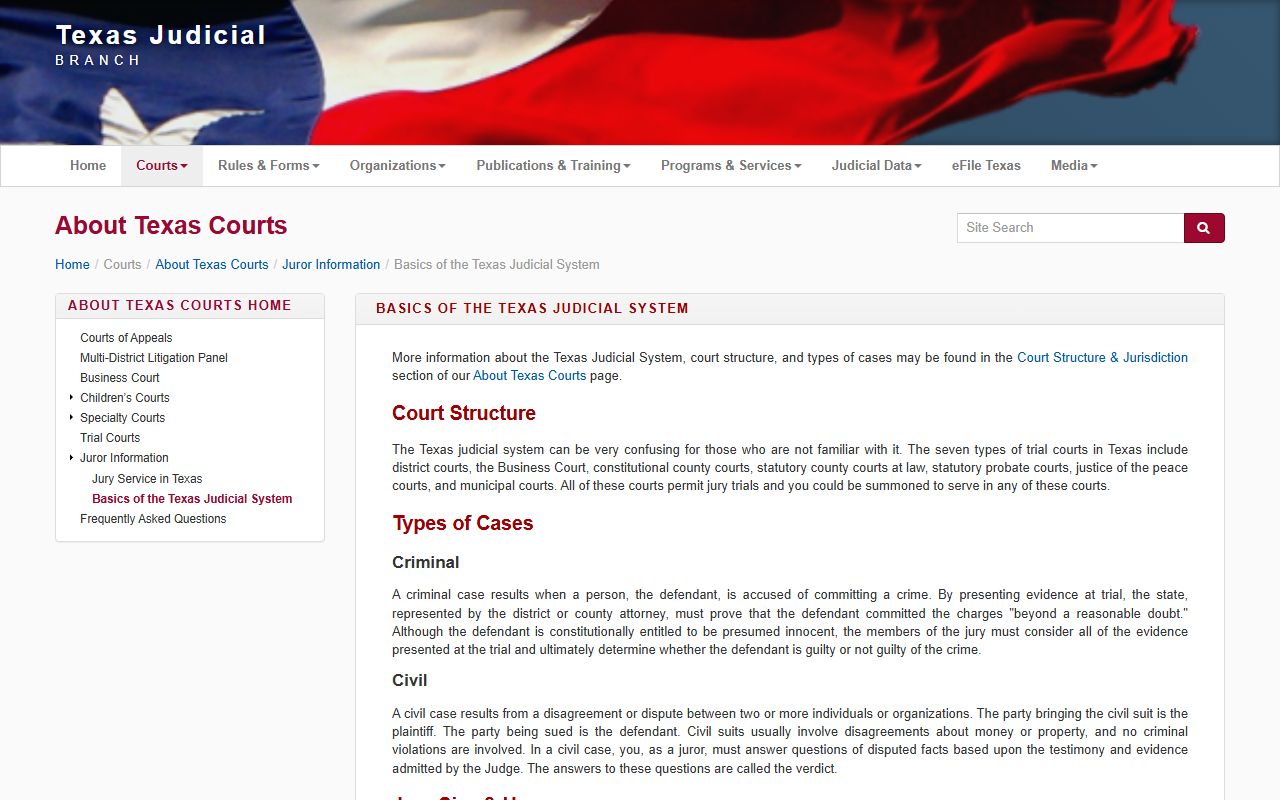
Public access in Texas grows out of the state court and government structure. The Texas Judicial Branch explains how the courts fit together, which helps when you decide whether a record is a court file or a county record. The image below comes from the Texas Judicial Branch system basics page.
The Public Information Act is the backbone for county records, but it works alongside court rules and a long list of privacy laws. The result is a system where most records stay open while sensitive data stays protected. When a record is denied, the requester can press the issue, and a state ruling may follow.
If Your Records Request Is Denied
A denial is not the end. If an office withholds a record, it usually must seek a ruling from the Texas Attorney General to confirm the record can be kept secret. You can ask for that ruling in writing and watch for the result. The Attorney General issues open records decisions that say whether a record must be released.
If the matter is a court file rather than a county record, the path is different. You petition the court that holds the file, since judicial records follow court rules under Section 552.0035. A subject of a record may also have a special right of access that a random member of the public does not. Keep copies of every request and response, and note each date.